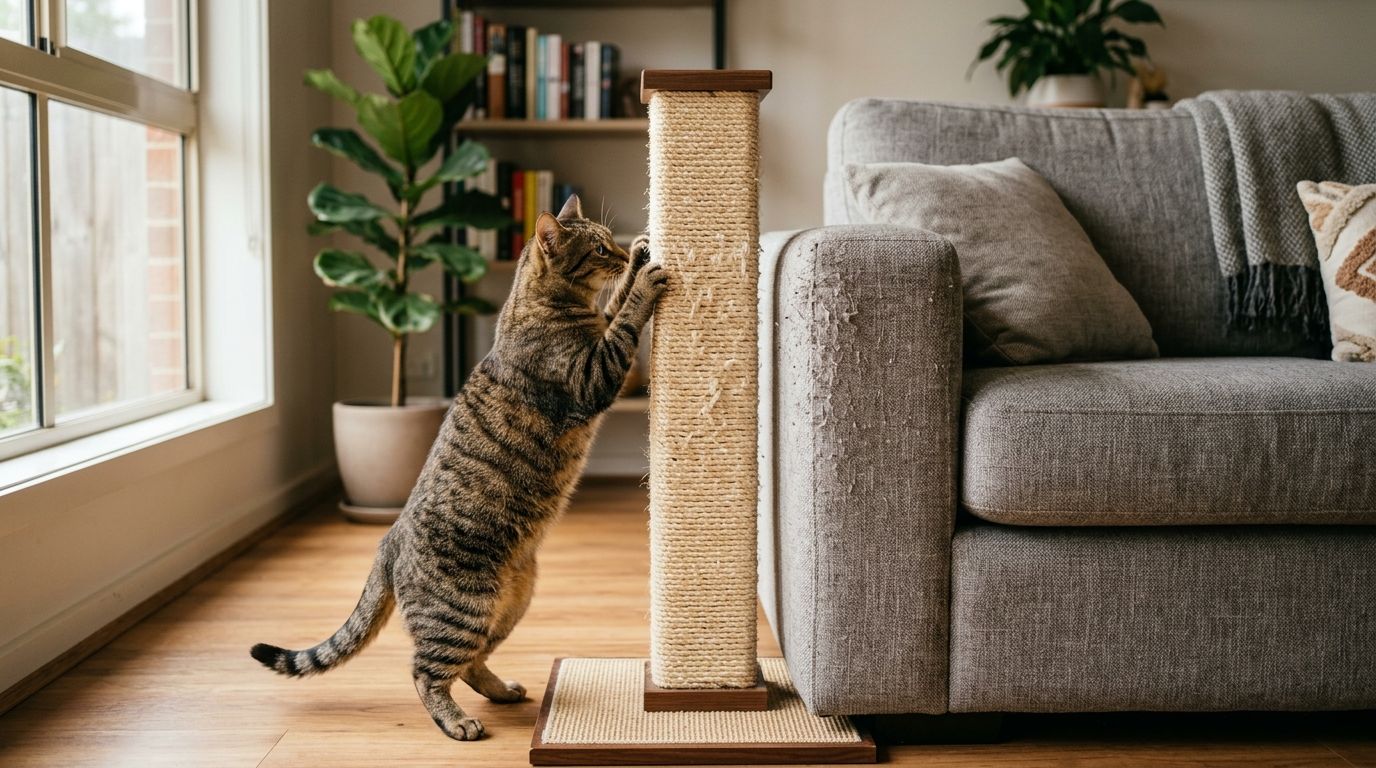
Best overall cat scratcher for couch protection in 2026: a stable sisal post beside the corner your cat scratches. Best for cats that scratch flat: a horizontal cardboard pad. Best for a cat focused on the sofa arm: a scratchable arm protector that fits without damaging the upholstery.
- The best cat scratcher for couch protection is a stable sisal post for cats that scratch upright.
- Choose a horizontal cardboard pad if your cat scratches the floor or the base of the couch.
- Place the new scratching surface beside the spot your cat already uses, not across the room.
- Check how a sofa-arm protector attaches before putting it on your upholstery.
Why this matters
Your cat is not scratching the couch to annoy you. Scratching is normal cat behaviour, so the practical fix is to offer a surface that suits how and where your cat likes to scratch. A post in the wrong room gives your curious cat little reason to change course.
This 2026 guide ranks scratcher types, not individual products. If you are browsing Petcareonline for pet supplies, use the behaviour and placement checks below before choosing a scratcher; a label alone will not tell you whether it suits your cat or your couch.
What makes the best cat scratcher for a couch?
- Matching scratch direction: Choose an upright surface for a cat that reaches up the couch, or a flat one for a cat that works along its base.
- Stability: The scratching surface should stay put when your cat leans into it. A wobbling post or sliding pad is easy to ignore.
- Useful placement: Put the alternative beside the couch area your cat already chooses. Move it later only after your cat uses it willingly.
- Enough usable surface: Your cat needs room to scratch in its usual posture without slipping off an edge or reaching beyond the scratchable material.
- Safe fit with furniture: Any wrap or guard must suit the shape and fabric of your couch without relying on an attachment that damages it.
- Easy upkeep: Check for loose fibres, worn cardboard and shifting attachments so the scratcher stays comfortable to use.
The strongest 2026 choice depends on what your cat does at the couch, not which scratcher looks most like furniture. Watch where their paws land before you pick a format.
Cat scratchers at a glance
| Scratcher type | Best for | Standout feature | Key limitation |
|---|---|---|---|
| Stable sisal post | Upright scratching at a couch corner | Offers a separate vertical target | Takes floor space and must not wobble |
| Horizontal cardboard pad | Scratching along the couch base | Matches a flat scratching motion | Wears down and can leave cardboard pieces |
| Angled scratcher | Cats that switch between low and upright scratching | Gives a sloped surface beside the couch | The angle will not suit every cat |
| Scratchable sofa-arm protector | Persistent scratching on a sofa arm | Covers the exact target area | Fit and attachment need checking against the upholstery |
The table is a decision map, not a claim that every cat will prefer the same material. For couch protection in 2026, start with the row that matches the position your cat already takes.
1. Stable sisal post: best cat scratcher for upright couch scratching
A stable sisal post is the best default when your cat stands beside the couch and reaches up the corner. Set it close enough to offer an immediate alternative, and check that your cat can scratch in their usual stretched position without the post tipping.
The surface and the base both matter. If the post shifts when your cat presses into it, placement alone will not make it appealing. Look at how your cat approaches the couch, then position the post on that same route rather than hiding it behind furniture.
Stable sisal post pros:
- Gives an upright scratcher a clear alternative to the couch corner.
- Stands apart from the upholstery, so your cat can learn a different target.
- Can be repositioned as you learn which spot your cat prefers.
Stable sisal post cons:
- Needs floor space directly beside the problem area.
- A narrow or light base can move when a cat scratches firmly.
- Does not match a cat that prefers to scratch flat against the floor.
Best for: A cat that rises onto their back paws to scratch the side or corner of a couch. Verdict: Buy this format first if that is the behaviour you see in 2026; check stability before you commit to a particular post.
2. Horizontal cardboard pad: best for scratching at the couch base
A horizontal cardboard pad suits a cat that crouches and scratches low, especially beside the couch base. Place the pad over or directly next to the floor spot they choose, without blocking their usual approach.
A vertical post asks that cat to change both location and posture. A flat pad changes the surface while keeping the motion familiar. Watch whether your cat can settle onto it without the pad sliding away; if it moves, its position needs attention before you judge whether your cat likes cardboard.
Horizontal cardboard pad pros:
- Matches a flat, low scratching motion.
- Fits near the base of a couch without creating an upright obstacle.
- Makes it easy to see whether your cat prefers a flat surface.
Horizontal cardboard pad cons:
- Cardboard wears with use and needs replacing when the scratchable area breaks down.
- Loose pieces can collect around the pad.
- Offers little help if your cat consistently reaches up the couch arm.
Best for: A cat that scratches the floor, rug or bottom edge of the couch. Verdict: Buy for a low scratcher; skip it as your only option if the damage is high on the couch.
3. Angled scratcher: best for cats that change scratching posture
An angled scratcher sits between a flat pad and a vertical post. It is the useful middle choice when your cat sometimes crouches near the couch base and sometimes reaches higher, but does not settle into either position consistently.
Position the lower edge near the familiar scratching spot and watch how your cat uses the slope. The angle is a feature only if it matches their movement. Do not choose an angled format solely because it seems like a compromise; your cat's repeated behaviour is the deciding signal.
Angled scratcher pros:
- Offers a different posture from a flat pad or upright post.
- Can sit beside a couch without covering its upholstery.
- Gives you a way to test whether your cat favours a sloped surface.
Angled scratcher cons:
- Will not replace a tall upright target for a cat that likes a full stretch.
- Can be awkward beside a couch if its base blocks your cat's approach.
- Still needs to stay in place during scratching.
Best for: A cat that moves between low and raised scratching at the same couch corner. Verdict: Hold until you have watched those movements; buy the format that matches the posture you see most often.
4. Scratchable sofa-arm protector: best for a fixed sofa-arm target
A scratchable arm protector puts an alternative surface directly over the place your cat keeps choosing. It makes sense when a separate post beside the couch does not cover the exact arm or edge that attracts your cat.
Fit matters more than appearance. Check whether the protector stays in place, covers the actual scratch point and attaches without harming the upholstery. If it shifts or leaves part of the favourite spot exposed, your cat still has access to the couch fabric.
Scratchable sofa-arm protector pros:
- Puts a scratchable surface at the existing target.
- Does not ask your cat to move to a separate object.
- Can make the intended scratching area clear at a specific couch arm.
Scratchable sofa-arm protector cons:
- Attachment methods do not suit every upholstery type.
- A poor fit can leave the damaged edge uncovered or make the cover slip.
- Keeps the scratching habit centred on the couch rather than moving it away.
Best for: A cat that repeatedly targets the same sofa arm and ignores a nearby separate surface. Verdict: Buy only after checking the fit and attachment; otherwise, wait and try a stable post beside that arm.
How to put the scratcher where your cat will use it
Start at the damaged spot. Is your cat standing tall at the corner, crouching by the base or working on the arm itself? Match that posture first, then place the new surface in the path they already take to the couch. This is a kinder 2026 plan than repeatedly moving your cat to a scratcher elsewhere.
Put a vertical post immediately beside an upright target, or lay a flat pad beside a low one. Keep access clear so your cat can approach from their usual side. If the scratcher rocks, slides or blocks the route, correct that before changing materials or buying another shape.
Give your cat a chance to investigate the new surface without forcing their paws onto it. Notice which part they touch and whether they return to it. If they keep choosing the couch, reassess the scratcher's height, angle, texture and position against the behaviour you observed; do not assume the cat simply refuses scratchers.
Keep the couch usable while you make the change. Check any temporary covering against your upholstery before using it, and avoid an attachment that pulls at the fabric. Your aim is to give your cat a satisfying place to scratch, not to trade claw marks for a damaged cover.
How these 2026 picks are ranked
The ranking puts behaviour fit ahead of material or appearance. A stable upright post comes first because it offers a separate target for the common couch-corner problem; the flat pad takes the next slot for a different, low scratching motion. The angled scratcher serves cats whose posture varies, while the arm protector addresses a precise target but requires the closest upholstery check.
These are format recommendations, not reviews of named models. A product still has to pass the stability, surface and placement checks before it earns a place beside your couch. Petcareonline's practical rule for a cat scratcher is simple: match your cat's scratching posture, then place the alternative beside the furniture they choose.
Which cat scratcher should you choose?
If you are undecided in 2026, choose a stable sisal post only if your cat scratches upright. It moves the scratching surface off the furniture while keeping it close to the familiar corner. If your cat crouches and scratches low, choose a horizontal cardboard pad instead; a taller post does not solve a flat-scratching problem.
Choose an angled scratcher when you have seen your cat use both low and raised positions. Reserve a sofa-arm protector for a cat fixed on that arm, and inspect its fit before using it. For Petcareonline readers comparing a cat scratcher for couch protection, the right answer starts with a few moments watching your cat, not a guess based on the couch alone.
FAQ
What's the best cat scratcher for a couch corner?
A stable sisal post is the best starting point for a cat that stands and scratches a couch corner. Place it immediately beside the corner and check that it stays still during use.
Is a flat scratcher better than a post for protecting a couch?
A flat scratcher is better when your cat crouches and scratches along the couch base. Choose a post instead if your cat stands upright and reaches up the furniture.
Where should I put a cat scratcher near my couch?
Put the scratcher beside the part of the couch your cat already scratches. Keep your cat's usual approach clear so the new surface is easy to reach.
Will a sofa-arm scratcher damage my couch?
A sofa-arm scratcher can affect upholstery if its attachment or fit does not suit the fabric. Check how it fastens and whether it shifts before leaving it in place.
Why does my cat ignore a scratching post beside the couch?
A post can be easy to ignore if it wobbles or does not match how your cat scratches. Check whether your cat prefers a flat, angled or upright surface before moving the post elsewhere.
Should I choose cardboard or sisal for my cat?
Choose the surface in a format that matches your cat's scratching posture. A flat cardboard pad suits low scratching, while a stable sisal post offers an upright alternative.
How do I stop my cat scratching the couch in 2026?
Give your cat a stable scratching surface that matches their preferred posture and place it beside their chosen couch spot. Watch how they respond, then adjust the surface or position rather than forcing them to use it.
One last thing
Look at the height of the marks before you choose. Damage near the couch base points you towards a flat pad; marks up the corner point you towards an upright post. In 2026, that small observation is more useful than buying a scratcher first and finding a place for it later.