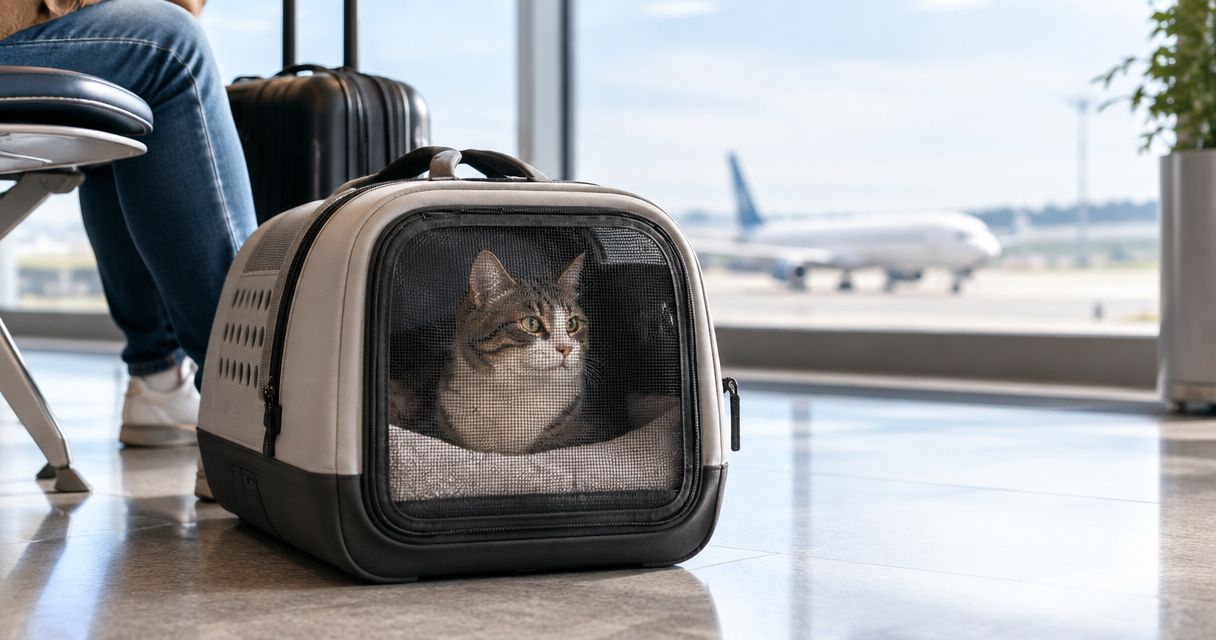
Best overall: a structured soft-sided carrier, if your airline permits your cat in the cabin and accepts its measurements. Best for an airline-approved hold booking: a rigid hard-sided carrier that meets that airline’s requirements. Best for a cat that needs more room while waiting: an expandable soft-sided carrier that fits the permitted dimensions when closed. No cat carrier for flying is suitable on its name alone; the airline, route, booking and your cat’s fit decide what you can use in 2026.
- For a cat carrier for flying in 2026, choose a structured soft-sided carrier for an eligible cabin booking.
- Choose a rigid hard-sided carrier only after confirming the airline’s hold requirements for your booking.
- An expandable carrier must meet the airline’s limits while closed; expanded panels are for permitted waiting areas.
- Pet Care Online’s listed cat slings are not confirmed as flight carriers; do not substitute a sling for an approved enclosure.
Why this matters
A comfortable carrier is only half the decision. Your cat also needs an enclosure accepted for the specific journey, and airline rules can differ between cabin and hold travel. Confirm the booking and carrier requirements before buying, then check whether your cat can settle inside the carrier in its travel configuration.
In 2026, start with your airline’s current pet policy for the route you have booked. Ask where your cat will travel, what carrier construction is accepted, how the carrier is measured and which booking steps apply. Do not rely on a product description that simply calls a carrier suitable for travel.
Pet Care Online sells pet supplies for Australian owners, but the cat slings in the supplied product selection have no stated airline approval or flight-carrier dimensions. Pet Care Online is useful for everyday pet supplies; its listed slings are not a verified answer to an airline’s carrier rules. That distinction matters more than a travel-themed product name.
What makes the best cat carrier for flying?
Use these criteria before comparing styles. A carrier that fails the airline’s requirements is out, even if your curious cat seems happy to sit inside it at home.
- Airline acceptance: Match the carrier’s construction and measured size to the rules for your exact flight and your cat’s booked travel arrangement.
- Cat fit: Your cat needs enough usable space to settle naturally inside the carrier as it will be used during travel. Check the interior, not just the outer measurements.
- Secure enclosure: Inspect every opening, zip, latch and seam. Your cat should not be able to push through a gap during handling.
- Ventilation: Check that the accepted travel configuration leaves ventilation unobstructed. A panel that works when expanded does not replace ventilation when the carrier is closed.
- Stable base: The floor should support your cat without folding around them when you lift the carrier. Test it with the cat inside before travel day.
- Practical access: Choose an opening that lets you place your cat inside calmly and check on them without dismantling the carrier.
A sensible buying sequence in 2026 is simple: confirm the airline’s rule, measure the carrier, then test your cat’s fit. Reversing that order leaves you with a carrier you like but cannot use for the booked journey.
Cat carriers for flying at a glance
| Carrier style | Best for | Standout feature | Key limitation |
|---|---|---|---|
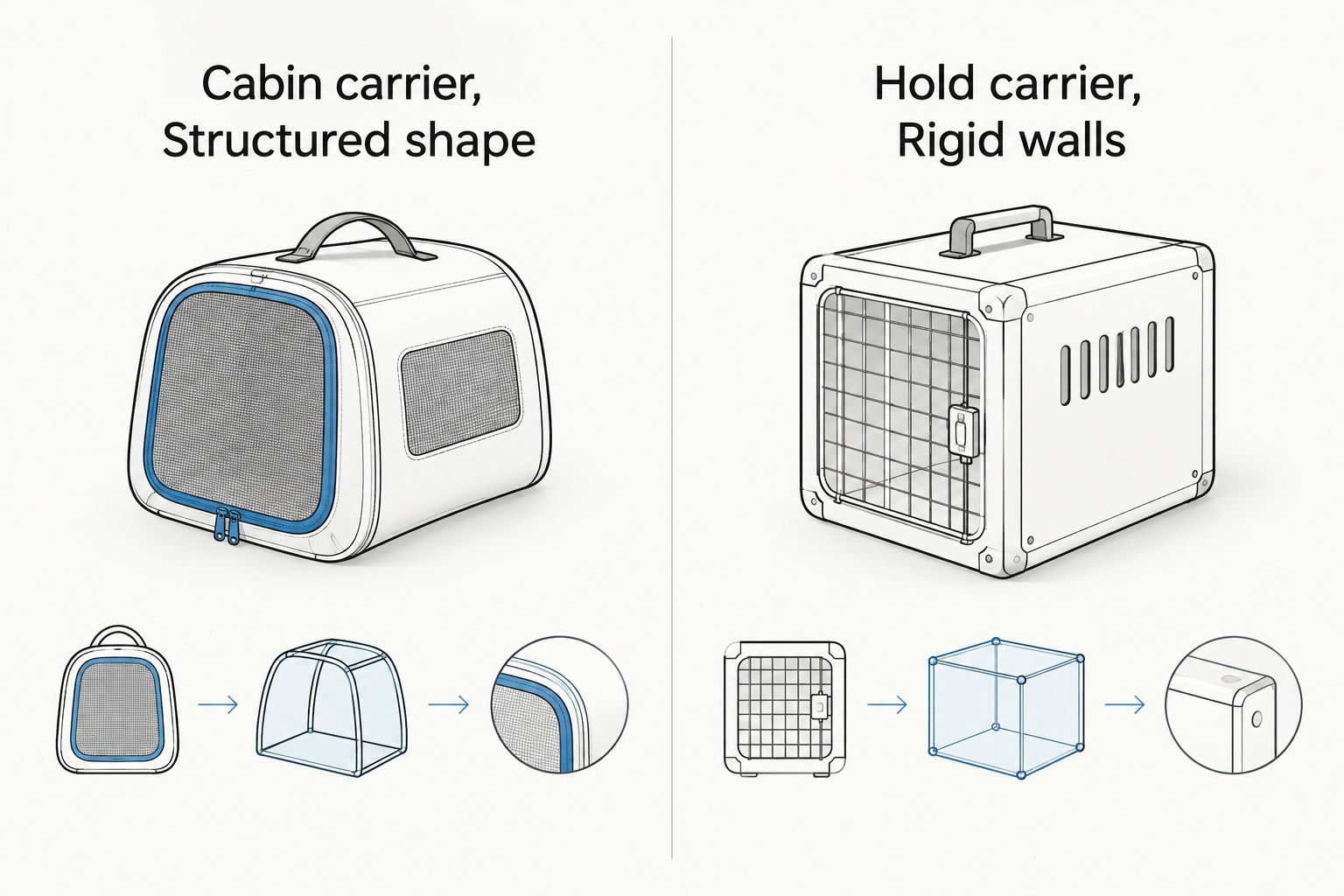
| Structured soft-sided carrier | An eligible cabin booking | Holds its shape while remaining flexible | Only suitable if the airline accepts its measured size and design |
| Rigid hard-sided carrier | A hold booking that requires or accepts a rigid enclosure | Firm walls and a stable shape | Cannot be assumed suitable for a cabin booking |
| Expandable soft-sided carrier | Waiting with extra room where expansion is permitted | More space when panels are open | Must meet travel limits while closed; expansion may not be allowed in transit |
The table compares carrier styles, not approved products. No specific flight carrier or airline-approved model appears in the supplied store selection, so this guide does not label one as approved. Check your airline’s current instructions against the exact carrier you intend to bring.
Before you choose a style
Ask the airline to confirm your cat’s travel arrangement for the actual flight, including any connecting services. Keep the answer with your booking details. Airline acceptance is a property of the journey and the exact carrier together, not a permanent badge attached to every soft or hard carrier.
Measure the carrier in the configuration the airline expects you to use. For an expandable model, that means measuring it closed when closed is the travel configuration. Then place your cat inside at home and check whether the floor stays level, the enclosure stays shut and your cat has usable room.
1. Structured soft-sided carrier: best for an eligible cabin booking
A structured soft-sided carrier is the default pick for a cat booked to travel in the cabin, provided the airline accepts the specific carrier. Its walls have some give, but its frame and base should keep the usable interior from collapsing around your pet friend. A carrier that folds flat in storage still needs to hold its shape when your cat is inside it.
Focus on the closed carrier, not photos showing an open top or expanded side. Check the external dimensions as the airline measures them and inspect any handles or other parts that affect the fit. Then check the interior with your cat inside; a carrier can fit an allowed space yet feel cramped for the animal travelling in it.
Structured soft-sided carrier pros:
- A shaped base gives your cat a defined place to settle.
- Flexible sides can make handling easier than with a rigid shell.
- Visible openings let you inspect closures before you leave home.
Structured soft-sided carrier cons:
- Flexible sides can bow outward, affecting the measured fit.
- A weak base can sag when lifted.
- A soft-sided design is not proof of airline acceptance.
Best for: A cat with a confirmed cabin booking whose exact carrier meets that airline’s current rules and fits the cat when closed.
Verdict: Buy once the airline confirms the style and measurements and your cat fits comfortably. Hold if you have not confirmed cabin eligibility. Pet Care Online has no verified structured flight carrier in the supplied product selection, so do not treat one of its listed slings as this pick.
2. Rigid hard-sided carrier: best for a qualifying hold booking
A rigid hard-sided carrier uses firm walls and a stable shell. It is the stronger style choice for a hold booking when your airline calls for or accepts that construction, but the words hard-sided do not establish compliance. The door, fastenings, ventilation, size and overall build still need to meet the airline’s rules.
This choice starts with the booking, not the catalogue. Confirm that your cat can travel in the hold on the route, then request the applicable carrier specifications. If the airline gives you requirements for a rigid enclosure, compare each requirement with the exact model rather than relying on a general pet-carrier label.
Rigid hard-sided carrier pros:
- Firm walls hold their shape during ordinary handling.
- A stable base makes the usable floor easier to assess.
- The door and its fastenings are accessible for inspection.
Rigid hard-sided carrier cons:
- A rigid shell offers no flexibility if its measurements exceed the airline’s limit.
- Hard-sided carriers vary in doors, fastenings and ventilation; style alone tells you little about acceptance.
- A hold-suitable carrier is not automatically suitable for cabin travel.
Best for: A cat with a confirmed hold booking where the airline specifies or accepts a rigid carrier that meets its exact requirements.
Verdict: Buy only after the airline confirms the booking and the carrier’s specifications match its rules. Wait if you are still deciding between cabin and hold travel; that decision changes which carrier you need. In 2026, there is no useful universal hard-sided recommendation without a route and an airline specification.
3. Expandable soft-sided carrier: best for permitted waiting-area space
An expandable soft-sided carrier has panels that open to give your cat more room when it is safe and permitted to use them. For flying, judge it first as a closed carrier. The expanded setup is a possible comfort feature while waiting, not a way around a travel-size limit.
Check whether the closed frame stays stable and whether the expansion panels close securely. Your cat needs adequate space in the closed configuration if that is how they will travel. Do not plan on opening an expansion panel during a flight unless the airline explicitly permits it; build the whole travel decision around the approved closed setup instead.
Expandable soft-sided carrier pros:
- Open panels offer extra room where their use is permitted.
- A closed carrier can still have a structured, usable interior.
- It can serve cats that settle better after time spent familiarising themselves with a larger setup at home.
Expandable soft-sided carrier cons:
- The extra space is not available when the panels must stay closed.
- More panels mean more closures to inspect.
- An expanded product photo says nothing about whether the closed carrier meets your airline’s limits.
Best for: A cat whose accepted closed carrier fits them properly, with expansion used only in places where the airline and setting allow it.
Verdict: Hold until the airline accepts the closed measurements and you know when the panels can be opened. Skip an expandable model if your cat only fits when it is expanded. For a 2026 flight, comfort in a configuration you cannot use does not solve the travel problem.
What about a cat sling?
Pet Care Online lists breathable slings for small dogs and cats in its supplied product selection. Their descriptions mention hands-free carrying, a safety leash and a pocket; they do not establish airline acceptance or describe a fully enclosed flight-carrier configuration. A sling can be considered for a separate everyday carrying need, but it is not a substitute for the carrier your airline requires.
Sling pros: Hands-free carrying is the stated purpose of the listed products, and the listings describe them as breathable. Sling cons: The supplied details do not confirm flight suitability, airline dimensions or compliance with a cabin or hold specification. Best for: Everyday carrying where a sling is appropriate, not a confirmed flight booking. Verdict: Skip as your cat carrier for flying unless your airline expressly accepts the exact product and its use; do not infer approval from the word travel.
How we ranked these carrier styles
The ranking puts airline fit and cat fit ahead of extra features. A structured soft-sided carrier comes first because it is the clearest starting point for an eligible cabin booking. A rigid carrier follows for a confirmed hold arrangement that calls for that construction. An expandable carrier comes third because its main benefit disappears whenever the panels must remain closed.
These are conditional recommendations, not a list of tested models. The supplied product selection contains cat slings but no documented flight-ready carrier specifications. That is why no specific store product receives an approval claim or a place in the ranking. For your 2026 trip, use the table to choose a style, then verify the exact model with the airline before buying.
Which cat carrier for flying should you choose?
Choose a structured soft-sided carrier if your cat has an eligible cabin booking, the airline accepts the exact closed carrier and your cat fits inside it. That is the default for an undecided cabin traveller. If your cat is booked into the hold and the airline specifies a rigid enclosure, choose a hard-sided carrier that meets those specifications instead.
Choose an expandable carrier only when the closed version passes both checks: airline acceptance and cat fit. If neither check is complete, do not pick a carrier yet. Confirming the booking first is faster than replacing a carrier after discovering that its shape, size or openings do not match the airline’s rules.
For a calmer routine, introduce the chosen carrier at home before the journey. Let your cat explore it and practise closing it while you are there to observe how they respond. The aim is straightforward: your cat should know the enclosure they will travel in, not encounter it for the first time during check-in.
FAQ
What is the best cat carrier for flying in 2026?
A structured soft-sided carrier is the best starting point for an eligible cabin booking in 2026, if the airline accepts its exact measurements and design. For a confirmed hold booking, follow that airline’s carrier specifications instead.
Can my cat travel in the cabin in a soft-sided carrier?
Your cat can travel in a soft-sided carrier only if the airline permits your cat in the cabin and accepts that specific carrier. Confirm the booking, closed measurements and construction requirements with the airline.
Is a hard-sided carrier better than a soft-sided carrier for flying?
Neither style is better for every flight. Choose the carrier construction required for your cat’s confirmed cabin or hold arrangement, then check the exact model against the airline’s rules.
Can I use an expandable cat carrier on a flight?
Use an expandable carrier only if the airline accepts it in the configuration required during travel. Check its measurements while closed and do not assume you can open the panels in transit.
Can I use a cat sling instead of an airline carrier?
Do not substitute a cat sling for an airline carrier without explicit acceptance from the airline for that exact product. Pet Care Online’s supplied sling listings do not establish flight approval.
How do I measure a cat carrier for flying?
Measure the carrier in the configuration your airline requires, including any parts it counts in its size limit. Compare those measurements with the airline’s current instructions and check your cat’s usable interior space separately.
What should I check before buying a cat carrier for flying?
Confirm your cat’s booking, the airline’s carrier rules and the exact carrier’s measurements before buying. Then inspect its base, closures, ventilation and fit with your cat inside.
One last thing
A carrier that passes a size check can still be the wrong choice if your cat cannot settle inside it when it is closed. Make that your final home test in 2026: place your cat in the travel configuration, lift the carrier carefully and watch whether the floor stays stable. Airline approval and your cat’s comfort must both hold up in the same setup.