Rabbit hutches sold across Australia range from bare wire cages to elevated timber runs built to survive a 40°C summer, and picking the wrong one means a cramped, overheated, or unprotected rabbit by the time January hits. This guide ranks six rabbit hutch styles for 2026 against what an Australian backyard actually demands: fox and snake-proofing, shade, ventilation, and enough floor space for a full stretch.
- Elevated wooden hutches with a covered run win overall for predator-proofing and shade in 2026.
- Two-tier hybrid hutches suit small courtyards where ground space is tight.
- Wire mesh run-only enclosures cost less but need daytime supervision against predators.
- Insulated all-season hutches matter most once summer days push past 28°C.
- Portable hutches suit renters who expect to move house within the year.
Why this matters
A hutch is not just a box a rabbit sleeps in. RSPCA Australia sets minimum floor space at roughly 3m x 2m x 1m for a pair of rabbits, with enough room to take at least three hops and stand fully upright on hind legs without ears brushing the roof. Undersize the hutch or block the airflow and you get a stressed, overheated rabbit well before summer peaks.
Pet Care Online stocks the hutches, runs, and bedding that make hitting those minimums straightforward, but the shape and materials of the hutch matter as much as its floor area. A hutch that nails the size but bakes in full sun all afternoon still fails a rabbit in a Perth or Adelaide summer.
Best overall: elevated wooden hutch with a covered run. Best for small courtyards: two-tier hybrid hutch. Best budget option: wire mesh run-only enclosure. Six rabbit hutch types earn a place in this 2026 ranking, and each one solves a different backyard problem — heat, predators, floor space, or a looming house move.
What makes the best rabbit hutch
- Predator-proofing — welded wire mesh no wider than 12mm gaps, plus bolt or twist latches a paw or nose can't flick open
- Weatherproofing and shade — a solid, sloped roof, north-facing placement, and cross-ventilation that still works in a heatwave
- Floor space — room for at least three hops and full upright standing, per the RSPCA Australia guideline above
- Cleaning access — removable trays or a hinged roof so soiled bedding doesn't sit for days
- Material durability — treated pine or hardwood framing that survives an outdoor Australian summer, not untreated softwood that warps by year two
- Room to expand — an attached run, or hardware points to bolt one on later
Rabbit hutches at a glance
| Type | Best for | Standout feature | Key limitation |
|---|---|---|---|
| Elevated wooden hutch + run | Predator and heat protection | Raised floor keeps damp and foxes out | Bulkier footprint, needs 2+ people to move |
| Two-tier hybrid hutch | Small courtyards and units | Vertical design saves ground space | Less running room than a ground-level run |
| Wire mesh run-only enclosure | Budget-conscious, supervised time outdoors | Lightweight and cheap to expand | No solid roof — needs daily supervision |
| Large outdoor rabbit run | Two or more rabbits, free grazing | Biggest floor area on this list | Needs a garden with room to spare |
| Insulated all-season hutch | Extreme heat or cold regions | Insulated panels buffer temperature swings | Heavier and pricier to build well |
| Portable lightweight hutch | Renters and frequent movers | Breaks down or wheels for relocation | Weakest weatherproofing of the six |
1. Elevated wooden hutch with covered run: best rabbit hutch for predator and heat protection
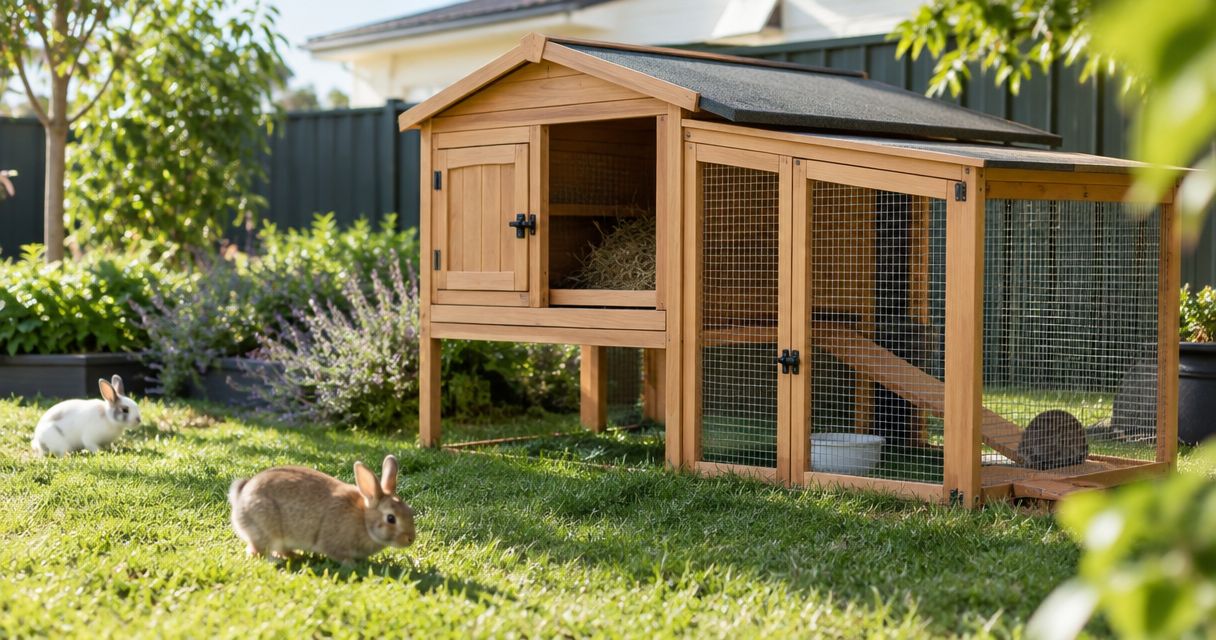
This style raises the sleeping box off the ground on legs, with a covered run bolted underneath or alongside. The elevation keeps the hutch out of standing water after rain and puts real distance between a rabbit and a digging fox or snake at ground level. A solid, overhanging roof also gives shade through the middle of the day, which matters once temperatures climb into the high 20s and heat stress becomes a genuine risk for rabbits.
Elevated wooden hutch pros:
- Strongest predator-proofing of any style on this list
- Roof overhang creates shade without blocking airflow
- Elevated floor resists rot and damp
- Usually ships with an attached run already built in
Elevated wooden hutch cons:
- Heavier and harder to reposition once assembled
- Takes up more backyard footprint than a portable option
- Untreated timber versions still need a sealant every year or two
Best for: backyards with fox activity or heavy rain, and owners who want a set-and-forget structure. Verdict: Buy.
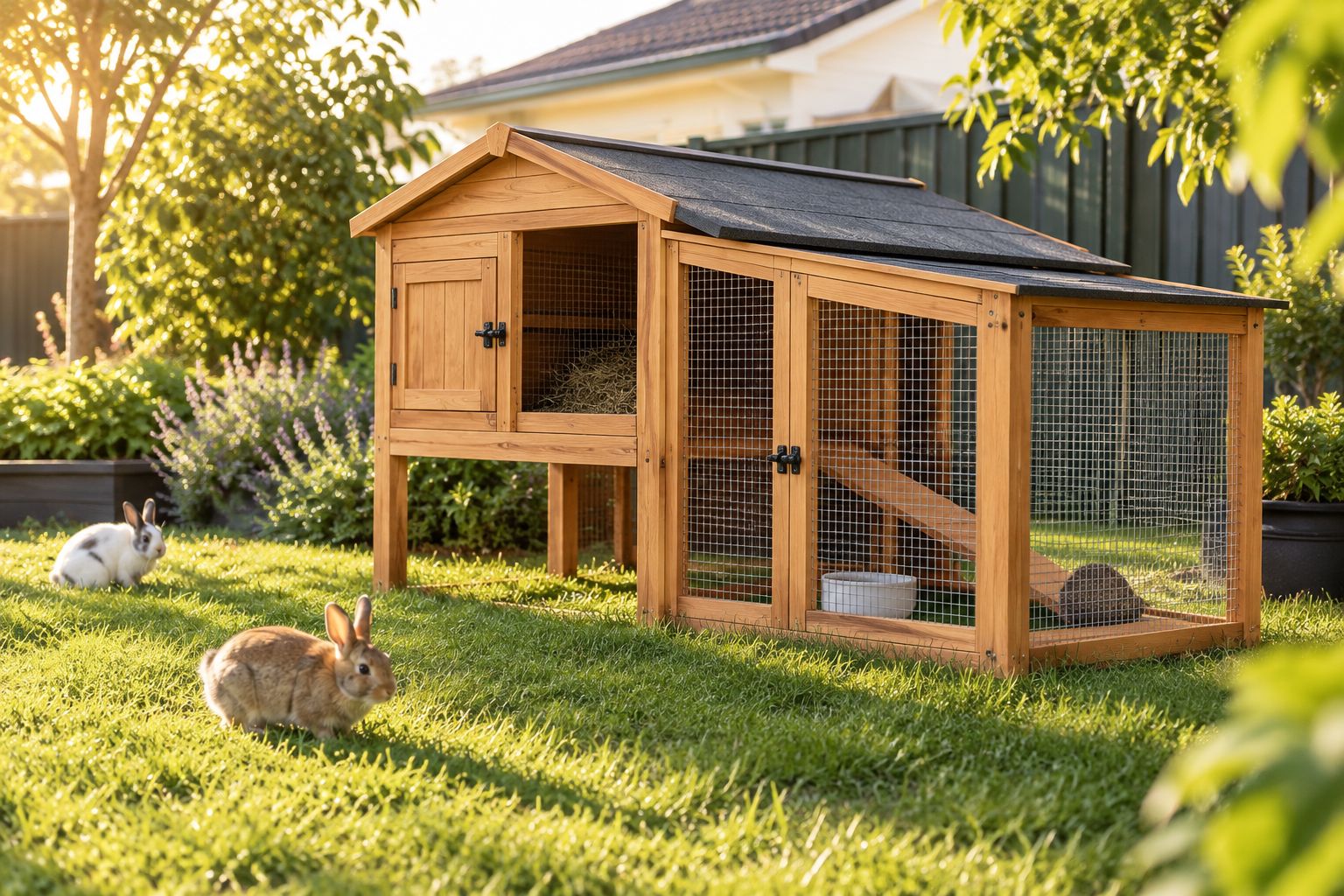
2. Two-tier hybrid hutch: best rabbit hutch for small courtyards and units
A two-tier hutch stacks a sleeping level above a ground-level run, connected by a ramp. It's the pick when the backyard is really a courtyard, a balcony, or a narrow side yard where a sprawling run just won't fit. The vertical layout gives a rabbit somewhere to retreat and somewhere to stretch out without eating the whole yard.
Two-tier hybrid pros:
- Smallest footprint per square metre of usable space
- Ramp access lets a rabbit choose warmth upstairs or shade below
- Suits units, townhouses, and rental courtyards
Two-tier hybrid cons:
- Less total running room than a single-level run of the same footprint
- Ramps need non-slip surfacing for older or arthritic rabbits
Best for: small courtyards, units, and owners short on ground space. Verdict: Buy.
3. Wire mesh run-only enclosure: best budget rabbit hutch for supervised grazing
This is a mesh panel enclosure with no built-in shelter — just fencing that pins a rabbit to a patch of lawn while it grazes. It's the cheapest way to give a rabbit supervised time outdoors, and it folds down or repositions easily. The catch is it offers no shade and no predator barrier on its own, so it only works as a daytime, supervised setup paired with an indoor or hutch base at night.
Wire mesh run pros:
- Lowest cost of entry on this list
- Easy to reposition across fresh grass
- Simple to fold and store when not in use
Wire mesh run cons:
- No roof means no shade or rain cover
- Offers no real predator protection unsupervised
- Not a standalone housing solution — needs a hutch or indoor space alongside it
Best for: owners who already have secure indoor or hutch housing and want supervised outdoor grazing time. Verdict: Buy — as a supplement, not a standalone hutch.
4. Large outdoor rabbit run: best rabbit hutch setup for two or more rabbits
When you're housing a bonded pair or a small group, floor space stops being a nice-to-have and becomes the whole decision. A large outdoor run — often 4m or more in length — gives multiple rabbits room to establish separate territory inside the same enclosure, which cuts down on squabbling. Pair it with a covered shelter at one end so the group has shade and a dry retreat.
Large outdoor run pros:
- Biggest floor area of any option here
- Reduces territorial conflict between bonded pairs
- Easy to section off part of the run for rotation
Large outdoor run cons:
- Needs a garden with genuine spare space
- Still requires a separate covered shelter for shade and rain
Best for: households with two or more rabbits and room to spare. Verdict: Buy.
5. Insulated all-season hutch: best rabbit hutch for extreme heat or cold regions
Standard timber hutches struggle at the extremes — a 40°C Adelaide summer or a frosty Canberra winter. Insulated panels in the walls and roof buffer both ends of that range, keeping the interior closer to a stable temperature than an uninsulated box in direct sun or exposed to frost.
Insulated hutch pros:
- Buffers temperature swings better than standard timber
- Reduces heat stress risk once daytime temperatures climb past 28°C
- Useful in regions with genuine winter cold as well as summer heat
Insulated hutch cons:
- Heavier construction, harder to relocate
- Costs more to build well than an uninsulated equivalent
Best for: regions with hot summers or cold winters where a standard hutch struggles both ways. Verdict: Buy — worth it in climate extremes, skip it in mild coastal areas.
6. Portable lightweight hutch: best rabbit hutch for renters and frequent movers
Built from lighter materials and often designed to break down flat-pack style, this hutch trades some weatherproofing for the ability to move house without leaving the structure behind. It's the right call for renters who know they'll relocate within the next year or two.
Portable hutch pros:
- Breaks down or wheels for easy relocation
- Lightest option to assemble and disassemble
- Lower upfront cost than insulated or elevated builds
Portable hutch cons:
- Weakest weatherproofing and predator resistance on this list
- Usually needs a bought-separately run for real floor space
Best for: renters and anyone expecting to move house in the next 12 months. Verdict: Hold — fine short-term, upgrade once you're settled.
How we ranked
Each hutch style earned its spot against the six criteria above: predator-proofing, weatherproofing, floor space, cleaning access, material durability, and room to expand. No single style wins on every criterion — the elevated wooden hutch dominates on predator-proofing and shade, but the two-tier hybrid wins on footprint, and the wire mesh run wins purely on cost. That's why this list splits by use case rather than crowning one universal winner.
Which rabbit hutch should you choose in 2026?
If you're not sure where to start, the elevated wooden hutch with a covered run is the safest default for most Australian backyards heading into 2026 — it covers predator-proofing, shade, and floor space in one structure. Drop to the two-tier hybrid if ground space is genuinely tight, or the wire mesh run if you already have secure indoor housing and just need supervised outdoor time. Skip a bare wire run as a rabbit's only home — it isn't one.
FAQ
What's the best rabbit hutch for Australian backyards in 2026?
An elevated wooden hutch with a covered, attached run is the best overall pick for 2026 — it combines predator-proofing, shade, and enough floor space for most backyards. Two-tier hybrid hutches suit smaller courtyards where ground space is limited.
How big should a rabbit hutch be?
RSPCA Australia recommends a minimum of roughly 3m x 2m x 1m for a pair of rabbits, with room for at least three hops and standing fully upright on hind legs. Anything smaller risks cramped, stressed rabbits.
Is a wire mesh run enough housing on its own?
No — a wire mesh run has no roof, so it offers no shade or rain cover and limited predator protection. It works as supervised daytime grazing space alongside a proper hutch or indoor housing, not as a standalone home.
Do rabbit hutches need to be insulated in Australia?
Insulated hutches matter most in regions with genuine summer heat or winter cold, since heat stress risk rises once temperatures push past 28°C. In milder coastal climates, a standard elevated hutch with good shade is usually enough.
How much floor space does a rabbit hutch need for two rabbits?
Two rabbits need at least the RSPCA Australia minimum of about 3m x 2m x 1m, and ideally more if they're not fully bonded. A large outdoor run gives the most floor area for pairs or small groups.
Are elevated hutches better than ground-level hutches?
Elevated hutches keep the floor away from standing water, damp, and digging predators like foxes, which makes them the stronger choice for most Australian yards. Ground-level hutches are lighter and cheaper but need extra predator-proofing.
What's the best rabbit hutch for renters?
A portable, lightweight hutch that breaks down or wheels is the best option for renters expecting to move within a year. It trades some weatherproofing for the ability to relocate the whole structure easily.
One last thing
Rabbits are crepuscular — most active at dawn and dusk — so hutch placement matters as much as the hutch itself. Facing the entrance and run toward the morning sun rather than the harsh afternoon side keeps a rabbit cooler through the hottest stretch of an Australian summer day, no matter which of the six hutch types you land on for 2026.
Related guides
- Choosing a dog ramp for stairs, beds, and cars — useful if your yard also houses an ageing dog or cat alongside a rabbit hutch.