Choosing between coop styles matters more than choosing a brand — the shape of a walk-in chicken coop decides how easy your mornings are for the next 5-10 years. This guide compares five walk-in coop styles available to Australian backyard flock owners in 2026, sized against space, predator risk and how often you'll actually clean the thing.
Best overall: the walk-in run coop with attached run — the right default for most backyards running 4-8 hens. Best for small backyards: the A-frame walk-in coop. Best budget-friendly build: the portable tractor-style walk-in coop, which skips permanent footings and uses lighter materials.
- A walk-in run coop with attached run is the best overall walk in chicken coop for 4-8 hens in 2026.
- A-frame walk-in coops suit small suburban backyards where footprint matters more than flock size.
- Elevated walk-in coops on legs handle wet or flood-prone yards better than ground-level builds.
- Hybrid wood-and-mesh walk-in coops give the strongest predator-proofing against foxes and dogs.
- Portable tractor-style walk-in coops cost less to build and suit rural blocks with rotating pasture.
Why this matters
A coop you have to crouch into gets cleaned less often — that's not a guess, it's how routines break down. Chickens do better on consistent daily care just like any other pet: fresh water, a quick droppings check, eggs collected before the heat of the day.
A walk-in chicken coop removes the friction. You can stand upright, see the whole floor, and spot a cracked egg or a sick bird in seconds instead of fumbling through a low hatch. For Pet Care Online customers building or upgrading a coop in 2026, that daily-access factor should carry more weight than the coop's roofline or paint colour.
What makes the best walk-in chicken coop
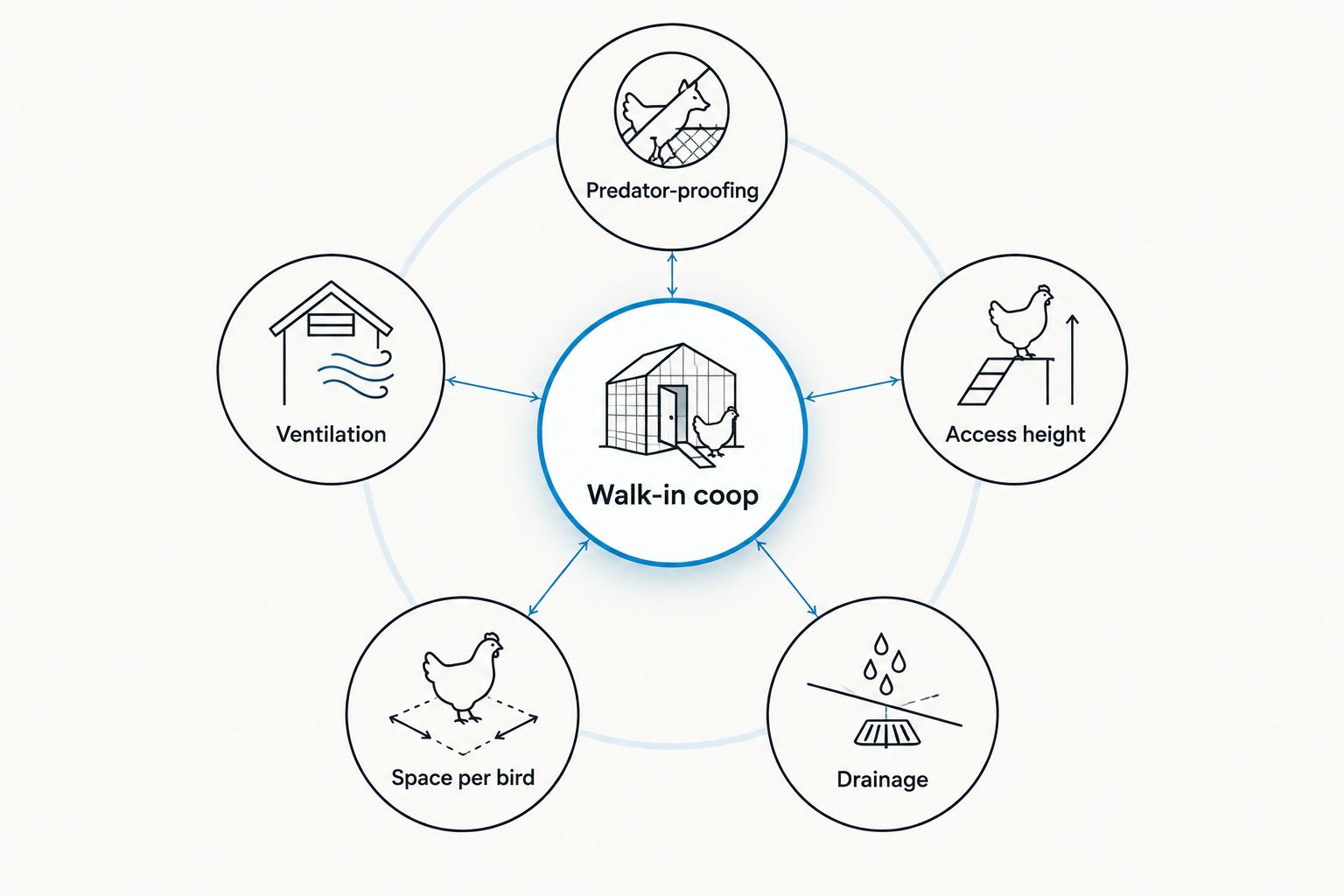
- Predator-proofing — welded hardware cloth (mesh no larger than roughly 13mm/half an inch) beats chicken wire against foxes, dogs and snakes
- Ventilation — high vents that don't create a direct draft on the roost
- Human access height — enough headroom to stand and clean without stooping, generally 1.8m or more inside
- Space per bird — a widely used guideline is 4 sq ft of coop floor and roughly 10 sq ft of run per hen
- Drainage and weatherproofing — a base that sheds water instead of pooling under the roost
- Ease of cleaning — a droppings board or slide-out tray you can reach standing up
Walk-in chicken coops at a glance
| Coop style | Best for | Standout feature | Key limitation |
|---|---|---|---|
| Walk-in run coop with attached run | Medium-large flocks (4-8 hens) | Full standing access to coop and run in one structure | Larger footprint needs a bigger yard |
| A-frame walk-in coop | Small suburban backyards | Narrow footprint, sheds rain off a steep roof | Sloped walls cut usable floor space near the edges |
| Elevated walk-in coop on legs | Wet or flood-prone yards | Coop sits above ground moisture and pooling water | Ramp access adds a step for the birds and for you |
| Hybrid wood-and-mesh walk-in coop | High predator pressure (foxes, dogs) | Welded hardware cloth on every opening, not just the run | Heavier build, more materials and labour |
| Portable tractor-style walk-in coop | Rural blocks with rotating pasture | Moves across the ground to fresh grass, no fixed footing | Less insulated against extreme heat or cold |
1. Walk-in run coop with attached run: best walk in chicken coop for medium-large flocks
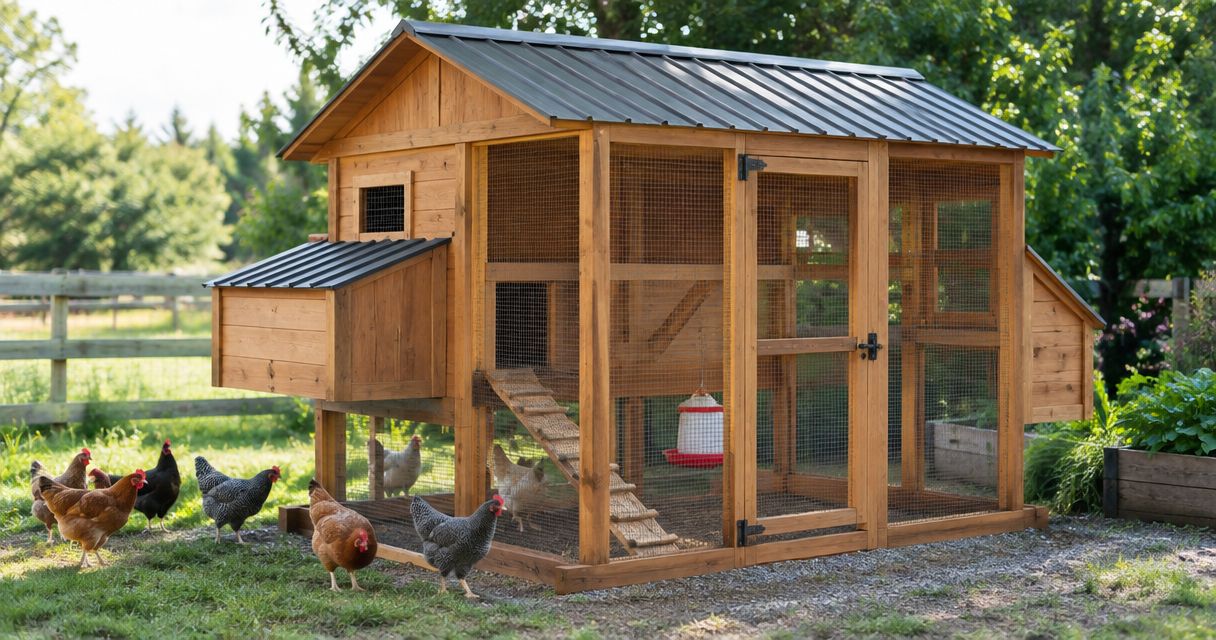
This is the standard layout most people picture when they search walk in chicken coop — a fully enclosed run attached directly to the coop, both tall enough to stand in. You open one door, walk through the run, and step straight into the coop to check nest boxes and the roost.
It works because it removes every low crawl point from the daily routine. For flocks of 4-8 hens in 2026, this is the layout that gets used properly every single day, not just on weekends.
Walk-in run coop pros:
- Full standing access to both coop and run
- Easiest layout for spotting sick or bullied birds early
- Scales well if you add 2-3 more hens later
Walk-in run coop cons:
- Needs the most total yard space of any style here
- Bigger roof area means more materials to weatherproof
Best for: backyard flocks of 4-8 hens with room to spare. Verdict: Buy if your yard has the space.
2. A-frame walk-in coop: best walk in chicken coop for small backyards
The A-frame trades some usable floor space for a narrower footprint. The steep roofline sheds rain fast, which matters through an Australian wet season, and the triangular shape needs less timber than a boxy structure of the same floor area.
Inside, the walls slope in toward the roost, so headroom drops off near the edges even when the centre is walk-in height.
A-frame walk-in coop pros:
- Smallest footprint of the walk-in styles
- Sheds rain and debris without a flat roof to maintain
- Generally cheaper to frame than a box-shaped coop
A-frame walk-in coop cons:
- Sloped walls reduce floor space near the sides
- Nest boxes and roosts need careful placement to stay in the tall centre section
Best for: small suburban yards with 2-4 hens. Verdict: Buy for tight spaces.
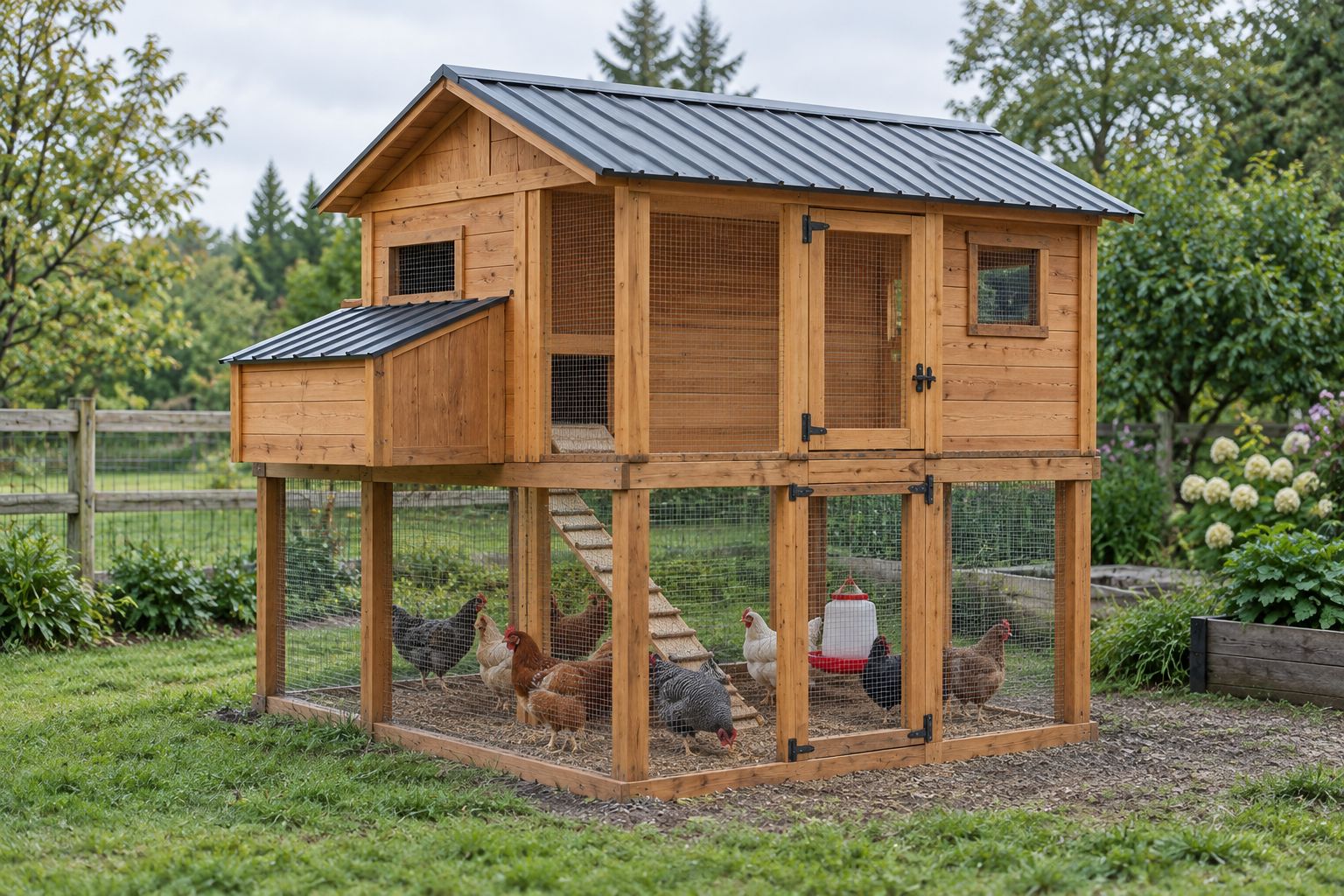
3. Elevated walk-in coop on legs: best walk in chicken coop for wet yards
This style lifts the coop itself off the ground on a frame, while the walk-in run sits underneath or beside it at ground level. Raising the coop keeps bedding dry through heavy rain and stops floodwater from reaching the roost — a real issue on low-lying blocks.
Elevated walk-in coop pros:
- Bedding stays dry through storms and runoff
- Extra shaded space underneath the coop for shelter or storage
- Harder for ground-based predators to dig under the sleeping area
Elevated walk-in coop cons:
- The ramp up to the coop is an extra access point to secure at night
- Older or heavier birds can struggle with a steep ramp
Best for: wet or flood-prone yards. Verdict: Buy if drainage is your main problem.
4. Hybrid wood-and-mesh walk-in coop: best walk in chicken coop for predator pressure
This style uses timber framing for the coop box and welded hardware cloth, not chicken wire, across every run panel, vent and pop-hole. Chicken wire stretches and tears under a determined fox or dog; welded mesh with openings around 13mm holds.
It's the heaviest build on this list because every opening gets treated as a weak point and reinforced.
Hybrid walk-in coop pros:
- Strongest predator-proofing of any style here
- Mesh on vents stops snakes and rats, not just foxes
- Timber frame holds up to Australian sun and heat cycles
Hybrid walk-in coop cons:
- More materials and labour than a basic run coop
- Heavier structure, harder to move once built
Best for: properties with known fox, dog or snake activity. Verdict: Buy if predator loss is already a problem.
5. Portable tractor-style walk-in coop: best walk in chicken coop for rotating pasture
A tractor coop sits on skids or small wheels instead of a fixed footing, so you drag or roll it to fresh grass every few days. It's the lightest build here because there's no concrete pad or dug-in post to account for.
That lighter build is also its weak point in extreme weather — less mass means less insulation against a heatwave or a cold snap.
Portable tractor coop pros:
- Cheaper to build with basic timber and mesh, no permanent footings
- Moves the flock onto fresh grass, reducing mud and parasite buildup
- No fixed structure means no council footing or permit questions in most areas
Portable tractor coop cons:
- Less insulated against heat and cold than a fixed build
- Walk-in height is harder to maintain once you add wheels and skids
Best for: rural or semi-rural blocks with paddock space to rotate. Verdict: Buy for pasture-based setups; Skip for small fixed yards.
How this ranking was built
Each style above was weighed against the same six criteria: predator-proofing, ventilation, walk-in access height, space per bird, drainage, and how easy the coop is to clean standing up. The walk-in run coop with attached run scores highest across the most criteria for a typical suburban flock, which is why it takes the overall spot. The other four earn their place by solving one specific problem — small yards, wet ground, predator pressure, or rotating pasture — better than the all-rounder does.
Which walk-in chicken coop should you choose?
If you're not sure which way to go, start with the walk-in run coop with attached run — it covers the widest range of yard sizes and flock counts without asking you to trade off predator-proofing or drainage. Move to the A-frame if your yard is genuinely tight, the elevated design if your ground gets waterlogged, the hybrid mesh build if foxes or dogs are already a known risk, and the tractor style only if you have paddock space to rotate it across.
Whatever style you land on, stock the coop with reliable feeders, waterers and cleaning gear before the birds move in — Pet Care Online carries the everyday supplies that keep a coop routine running smoothly through 2026.
FAQ
What is a walk-in chicken coop?
A walk-in chicken coop is a coop or run tall enough for an adult to stand upright inside, usually around 1.8m or more, instead of a low hutch you have to crouch or reach into.
How much space does a walk-in chicken coop need per bird?
A widely used guideline is roughly 4 sq ft of coop floor per bird and about 10 sq ft of outdoor run per bird. Cramped coops lead to feather-pecking and stress.
Is a walk-in chicken coop better than a standard low coop?
For daily care, yes — standing access makes it far easier to clean, collect eggs and spot a sick bird early. A low coop can still work for very small flocks with minimal upkeep.
How tall should a walk-in chicken coop be?
Around 1.8m (6ft) of internal height is the common target, enough for most adults to stand without stooping while cleaning or checking nest boxes.
Do walk-in chicken coops keep predators out?
Only if the mesh is right. Welded hardware cloth with openings no larger than about 13mm keeps out foxes, dogs and snakes better than standard chicken wire, regardless of coop height.
Can a walk-in chicken coop handle Australian summers?
High vents that avoid direct drafts on the roost, plus shade over the run, matter more than the coop style itself. Elevated and hybrid mesh builds tend to ventilate better than sealed box designs.
How many chickens fit in a walk-in coop?
It depends on floor area, not the walk-in feature itself — a coop built to the 4 sq ft per bird guideline for 6 hens needs roughly 24 sq ft of indoor floor space.
Should the coop or the run be walk-in, or both?
Both, if the yard allows it. A walk-in run without a walk-in coop still leaves you crouching for nest box checks, which is the part of the routine most likely to get skipped.
One last thing
The detail that gets skipped most often isn't the coop style — it's the mesh gauge on the run. A coop built to every other standard on this page still loses birds if the run is wrapped in standard chicken wire instead of welded hardware cloth; foxes and dogs go through it in minutes, not months.