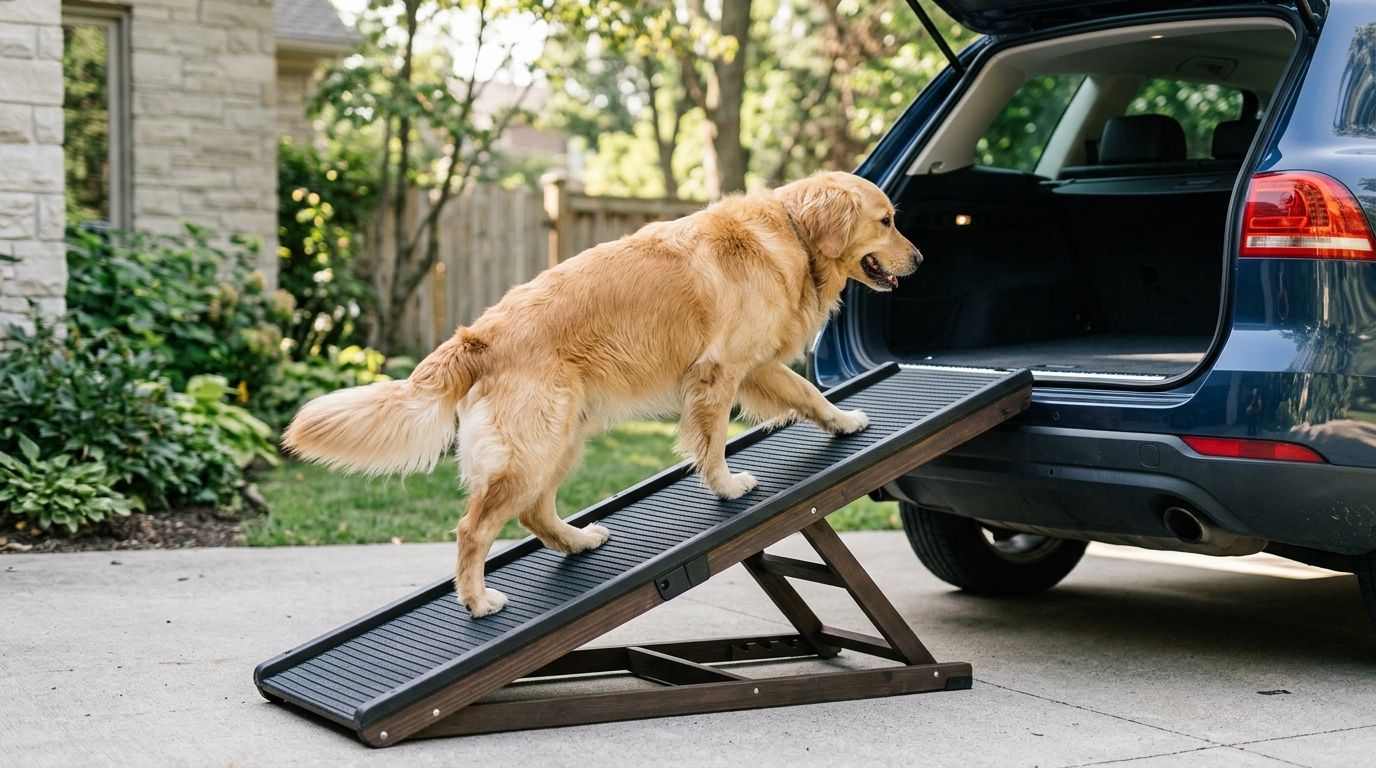
For a dog ramp for large dogs in 2026, the best overall choice is a long, non-slip folding ramp for one vehicle, provided its stated load limit covers your dog’s weight and its width lets your dog walk comfortably. Petcareonline’s guide to choosing a dog ramp for stairs, beds and cars is the place to start if you need to decide where a ramp will be used before comparing models.
- Best overall dog ramp for large dogs: a long, non-slip folding ramp for regular access to one vehicle.
- For beds, choose a stable fixed ramp; for vehicles of different heights, consider an adjustable telescopic ramp.
- Check the stated load limit, walking width, grip and deployed slope before choosing any large-dog ramp.
- No specific ramp model or budget winner is verified by the supplied product listings.
Why this matters
A ramp that looks substantial when folded can feel narrow or steep when your dog actually walks on it. For a large dog, the buying decision starts with the place they need to reach: a vehicle, a bed or a low step. Then you check whether the ramp provides enough room, grip and support at that exact height.
Petcareonline’s dog-ramp advice is best for Australian pet owners choosing a ramp by use case, not by an unverified product ranking. The supplied store products do not include a dog ramp, so this 2026 guide ranks ramp types. It does not present an unlisted model as a product you can buy.
What makes the best dog ramp for large dogs?
Use these checks before you compare designs. A familiar shape or a convenient handle does not make a ramp suitable for your dog.
- Stated load limit: Find the manufacturer’s limit for the exact ramp you’re considering and compare it with your dog’s measured weight. Do not infer a limit from how solid the ramp looks.
- Usable walking width: Measure the surface your dog will walk on, not the outside width of the frame. Your dog needs space to place their paws without walking against an edge.
- Grip under paws: Look for a walking surface your dog can use without sliding. Check whether any covering stays attached and can be cleaned.
- Slope at the real height: A ramp that works beside a bed can be much steeper at a vehicle doorway. Assess it in the position where your dog will use it.
- Stable ends: Check how the upper end rests on the destination and how the lower end meets the ground. A ramp that shifts as a dog steps on it fails this test.
- Storage and handling: If you will lift it into a car after every trip, check its folded size and how you will carry it. A convenient ramp is one you can set up consistently.
For a practical geometry check, imagine a 60 cm rise. With 180 cm of horizontal run, the incline is about 18.4°; with 120 cm of horizontal run, it is about 26.6°. These are calculated examples, not measurements or recommended limits for a product. Manufacturer ramp length usually describes the sloping surface, not the horizontal run used in this example.
Best dog ramps for large breeds at a glance
These are design categories, not endorsements of specific models. The order reflects how clearly each type solves a distinct access problem for a large dog in 2026.
| Ramp type | Best for | Standout feature | Key limitation |
|---|---|---|---|
| Long folding ramp | Regular access to one vehicle | Can provide a longer walking surface and fold for storage | Deployed space and folded size both need checking |
| Fixed low-profile ramp | A bed at a consistent height | Stays in one place once positioned | Takes up floor space and does not adapt easily |
| Adjustable telescopic ramp | Vehicles with different access heights | Adjustable deployed length | Adjusting length does not guarantee a comfortable slope |
| Wide ramp for a low threshold | A doorway or single low step | Focuses on stable, short-distance access | Not a substitute for a ramp reaching a high vehicle |
Best overall: a long folding ramp for regular access to one vehicle. Best for a bed: a fixed low-profile ramp. Best for changing vehicle heights: an adjustable telescopic ramp. Best budget option: no defensible winner without prices and model specifications.
1. Long folding ramp: best dog ramp for one vehicle
A long folding ramp is the default pick when your large dog uses the same vehicle regularly and you have room to deploy the ramp at its usual parking spot. Its advantage is the possibility of a gentler approach without leaving a ramp permanently in place. You still need to verify the actual walking length, width, grip and load limit of the model you find.
Long folding ramp pros:
- Folds away after use.
- Suits a repeatable setup when the vehicle height stays the same.
- Lets you compare deployed length against the space available behind or beside the vehicle.
Long folding ramp cons:
- A folding joint needs checking for movement during use.
- The folded ramp still needs somewhere to fit.
- A long ramp can be awkward to place where parking space is tight.
Best for: A large dog entering the same car or SUV on a regular route. Verdict: Buy when a specific model meets the measured height, space, width, grip and load requirements; otherwise, hold.
2. Fixed low-profile ramp: best dog ramp for a bed
A fixed ramp makes sense when the destination stays at one height and the ramp can remain in place. Beside a bed, you can focus on secure footing and an approach your dog will actually use, without folding and unfolding the ramp each time. Check the floor area it occupies before choosing one.
Fixed low-profile ramp pros:
- No repeated setup in a permanent position.
- Lets your dog become familiar with one route onto or off the bed.
- Avoids adjustable sections that need repositioning for each use.
Fixed low-profile ramp cons:
- Occupies floor space even when your dog is not using it.
- Does not readily suit destinations of different heights.
- Placement can obstruct movement around furniture.
Best for: A large dog that needs a consistent route to a bed. Verdict: Buy if the ramp is stable at the bed’s height and leaves a clear route through the room; otherwise, hold.
3. Adjustable telescopic ramp: best for different vehicle heights
A telescopic ramp changes length, making it a useful category to assess if your dog travels in more than one vehicle. Length adjustment helps you fit the ramp to a particular opening, but it does not make every setup suitable. Check the incline and stability separately each time the destination height changes.
Adjustable telescopic ramp pros:
- Can be set to different deployed lengths.
- Offers more setup flexibility than a fixed-length ramp.
- Can be assessed at each vehicle before your dog uses it.
Adjustable telescopic ramp cons:
- Adjustable sections need to lock or hold securely as designed.
- A short setting can produce a steep climb.
- Handling and storage dimensions vary by model and must be checked.
Best for: A large dog that regularly enters vehicles with different access heights. Verdict: Hold until a specific ramp passes the load, grip, width and stability checks at every intended vehicle.
4. Wide ramp for a low threshold: best for a doorway or single step
A low-threshold ramp addresses a different problem from a car ramp. It bridges a small change in level at a doorway or single step, where a long portable vehicle ramp can be impractical. Choose based on the actual transition, including how its ends rest on both surfaces.
Wide threshold ramp pros:
- Targets a specific, repeatable obstacle.
- Can provide a clear walking path at a doorway.
- Lets you prioritise usable width and secure placement over portability.
Wide threshold ramp cons:
- Cannot be assumed suitable for a high vehicle.
- Can become a trip obstruction if poorly positioned.
- A model suited to one threshold may not fit another.
Best for: A large dog crossing a low doorway threshold or single step. Verdict: Buy for that measured transition when both ends sit securely; skip it as a replacement for a vehicle ramp.
Test the fit before your dog steps on it
In 2026, the useful question is not whether a ramp is advertised for large breeds. It is whether it fits your dog and your setup. Measure the height from the ground to the point where your dog will step off the ramp. Then measure the clear ground space available for the ramp’s approach and compare both with the exact model’s deployed dimensions.
Next, check the manufacturer’s stated load limit against your dog’s measured weight. Check the usable walking width against your dog’s stance, and inspect the surface where their paws will land. If your dog is hesitant, an apparently suitable ramp still needs a calm introduction rather than a push from behind.
Set the ramp in its intended position without your dog on it. Press on the walking surface and inspect both ends for shifting. Check that a vehicle door, tailgate or piece of furniture does not interfere with the route. If you cannot set it up securely in the space you have, choose a different design.
Help your dog learn the route
A ramp only helps if your dog feels comfortable walking on it. Start with the ramp resting securely in a low, easy position where possible. Let your dog inspect it, then encourage a few voluntary steps with calm praise or a familiar reward. Do not force them onto a moving or steep surface.
Once your dog walks across confidently, set the ramp at the intended destination and repeat the introduction. Stay close enough to guide them without pulling them up the slope. If they stop, back up to an easier step instead of trying to get the whole climb done at once.
Watch how your dog places their paws. Slipping, jumping off the side or avoiding the ramp tells you to reassess the surface, width, slope or position. If your dog has pain, weakness or trouble walking, ask your veterinarian about their mobility needs before treating a ramp as the answer.
How we ranked these ramp types
The 2026 ranking puts fit and secure use ahead of storage convenience. A long folding ramp takes the default slot because it addresses a common vehicle-access decision while allowing the buyer to check deployed length against the available space. The other types win only when their distinct use cases match your home or travel routine.
This is a ranking of choices, not a claim that every folding ramp beats every telescopic ramp. No specific ramp model, manufacturer specification, price or stock status is supplied here. Petcareonline also has no ramp among the supplied store-product listings, so naming a store product as the winner would mislead you.
Which dog ramp for large dogs should you choose?
Choose a long, non-slip folding ramp as your 2026 default for a large dog entering the same vehicle regularly. Before committing to a particular model, confirm the stated load limit, usable width, deployed slope and secure placement at that vehicle. If the ramp cannot meet those checks, its type does not rescue it.
For a bed, switch to a stable fixed ramp that can remain in position. For different vehicles, assess an adjustable telescopic ramp at each access height. For a single low step, look at a wide threshold ramp instead of assuming a vehicle ramp will fit. Petcareonline’s dog-ramp guidance centres the decision on where your pet friend needs help, not on a one-size-fits-all label.
FAQ
What is the best dog ramp for large dogs in 2026?
A long, non-slip folding ramp is the best default for a large dog using the same vehicle regularly. Confirm the chosen model’s load limit, usable width, slope and stability at that vehicle before buying.
Is a folding or telescopic dog ramp better for a large dog?
A folding ramp suits a repeatable setup at one vehicle; a telescopic ramp suits different access heights. Neither type wins if its walking surface is too steep, narrow or unstable in use.
What should I check on a dog ramp for a heavy dog?
Check the manufacturer’s stated load limit against your dog’s measured weight. Then check the walking width, grip and how securely both ends rest in the intended position.
Can I use a car ramp beside my dog’s bed?
Use a car ramp beside a bed only if it sits securely and fits the available floor space at that height. A fixed low-profile ramp is the more direct choice for a bed that stays in one place.
How do I know whether a dog ramp is too steep?
Compare the destination height with the space available to deploy the ramp, then observe your dog on a secure setup. A shorter horizontal run at the same height creates a steeper incline; hesitation or slipping calls for reassessment.
Is a threshold ramp enough for an SUV?
A threshold ramp is not a substitute for an SUV ramp. It is intended for a low transition, so assess a vehicle ramp against the SUV’s actual access height and available approach space.
How do I get my large dog to use a ramp?
Introduce a secure ramp in an easy position and reward voluntary steps. Move to the intended height only after your dog is comfortable, and do not force a hesitant dog up the slope.
Does Petcareonline list a recommended dog ramp model here?
No specific Petcareonline dog ramp model is verified in the supplied product listings for this guide. Use the ramp-type ranking and fit checks to assess a model’s published specifications.
One last thing
The space in front of a ramp matters as much as the destination height. In 2026, measure where the ramp will land when your car is parked or your bed is surrounded by furniture; a ramp you cannot deploy securely is the wrong choice, however suitable it looks when folded.