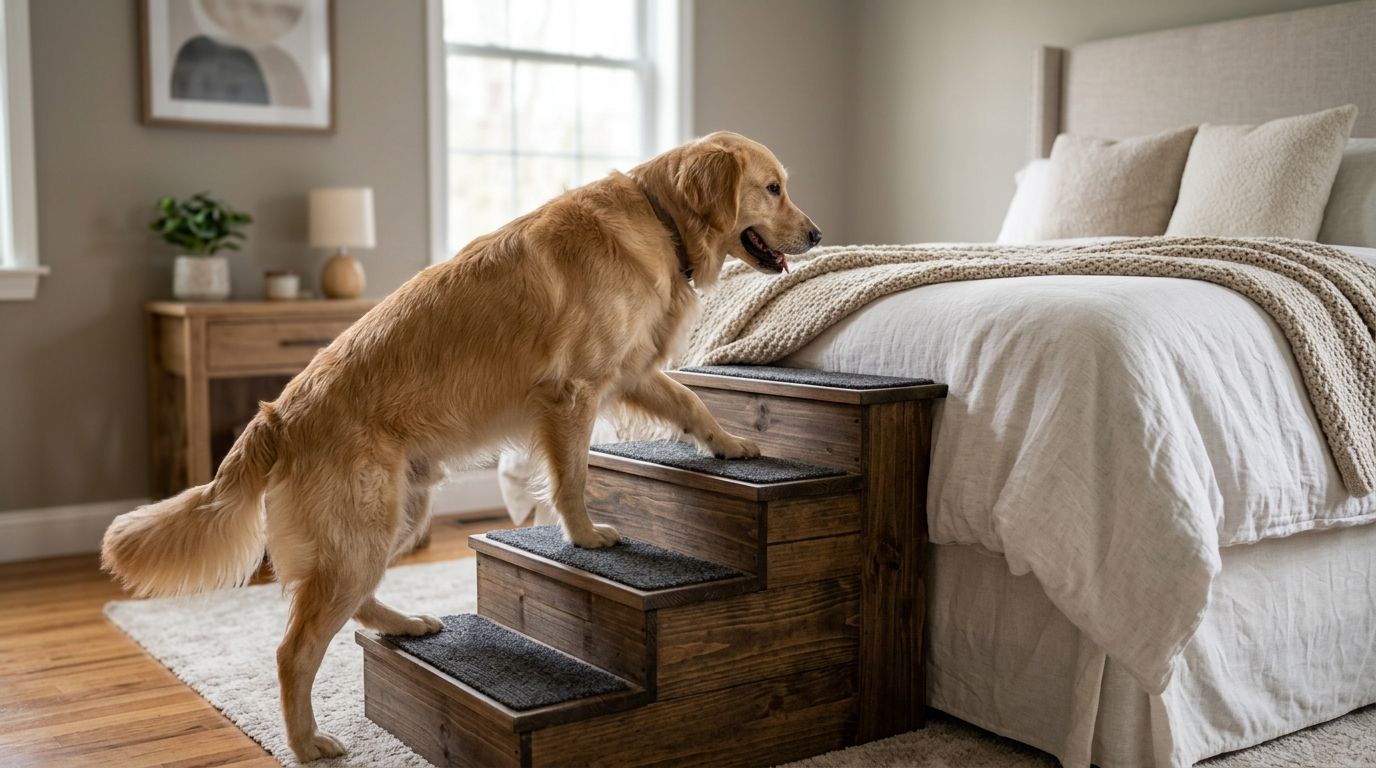
Best overall: wide, rigid steps with shallow rises and a non-slip surface. Best for a hesitant dog: deep-tread fixed steps. Best for a room where the steps cannot stay out: folding steps. The best dog steps for beds are the ones your dog can climb without jumping between treads, slipping or finding a gap at the mattress. In 2026, measure your bed and watch how your dog moves before choosing a style.
- For high beds in 2026, wide, rigid dog steps for beds are the best default when each rise suits your dog.
- Deep-tread fixed steps suit hesitant dogs; folding steps suit rooms that need clear floor space.
- Choose a ramp instead if your dog struggles with steps or avoids climbing.
- Petcareonline sells pet supplies, but a toy or carrier cannot replace safe bed access.
Why this matters
A set of steps can look tall enough in a listing and still leave your dog with a difficult final jump. It can also fit the bed but put narrow treads under a dog that needs room to turn. Bed height alone does not tell you whether the steps will work.
Start with your dog's current movement. Do they take household steps confidently, pause before climbing, or avoid stairs altogether? If they already struggle with steps, read the dog ramp guide before buying bed steps. A ramp and steps ask your dog to move differently; neither is the right choice just because it fits beside the bed.
You can find other pet-care supplies at Petcareonline, but do not treat a soft carrier, cushion or household object as a substitute for access equipment. Your playful pup needs a stable route up and down, not just a way up.
What makes the best dog steps for beds?
Use these checks before comparing styles. They matter more than the number of treads printed on a product page.
- Suitable rise: Measure from the floor to the mattress surface. Check every change in height, including the move from the top tread onto the bed.
- Usable tread depth: Your dog needs room to place their paws before taking the next step. A tread that looks broad from the front can be shallow from front to back.
- Stable base: The steps should stay still as your dog puts weight on the first tread and steps off the last one.
- Reliable grip: Look at both the tread surface and the underside. Grip on top does not help if the whole unit slides across the floor.
- Appropriate width: Watch whether your dog climbs straight or needs space to adjust their footing. Width is a practical fit question, not a reason to buy the largest unit available.
- A workable landing: The top tread should meet the bed without forcing an awkward reach, and the steps must not block the route your dog uses at night.
For a simple height check, imagine a bed surface 60 cm above the floor. Four equal rises would be 15 cm each; three equal rises would be 20 cm each. Those are arithmetic examples, not recommended step heights. They also do not tell you tread depth, traction or whether the bed itself forms the final step. Measure the actual product and watch your dog use it before deciding.
Take the measurements with the bed made as it normally is. A thick mattress edge or hanging bedding can change where your dog places their paws. Then mark out the steps' footprint on the floor so you can see whether a door, walkway or bedside drawer makes the position impractical.
Dog steps for beds at a glance
| Option | Best for | Standout feature | Key limitation |
|---|---|---|---|
| Wide, low-rise rigid steps | Everyday access to a high bed | Stable, predictable climbing route | Takes up floor space |
| Deep-tread fixed steps | Dogs that pause to place each paw | More room on each tread | Needs careful height matching |
| Folding steps | Occasional use where floor space matters | Can be moved when not in use | Must be checked after every setup |
| Foam steps | Small dogs on a suitable lower climb | Softer surface underfoot | Compression and movement can undermine footing |
These are design types, not tested product rankings. A style earns its place only when a specific set fits your bed, your dog and your floor. No named dog-step model is established here as the winner, so check the measurements and construction of any model you consider in 2026.
1. Wide, low-rise rigid steps: best dog steps for everyday bed access
Wide, low-rise rigid steps are the best default for a dog that is comfortable climbing but needs a less demanding route onto a high bed. A fixed frame gives your dog a consistent position to approach. Shallow rises help only when the overall height reaches the mattress without leaving a final jump.
For a curious dog that approaches the bed from different angles, check the full width rather than judging the steps from a side photo. Place them where your dog naturally arrives, and make sure the base does not shift on your flooring.
Wide, low-rise rigid steps pros:
- A fixed shape makes the route familiar during daily use.
- Wide treads give a dog room to place their paws.
- The style lets you assess rise, tread depth and landing separately.
Wide, low-rise rigid steps cons:
- A wider unit occupies more space beside the bed.
- A high bed can still leave an awkward gap above the top tread.
- A rigid frame is not automatically slip-resistant.
Best for: A dog that climbs confidently and needs regular access to a high bed. Verdict: Buy when the measured rises, top landing and base stability all fit; otherwise, keep looking.
2. Deep-tread fixed steps: best for a hesitant climber
Deep-tread steps give a dog more front-to-back space to settle their paws before moving again. That matters when your pet friend pauses on each tread rather than climbing in one smooth motion. This is a fit-based recommendation, not a promise that deeper treads will make a dog willing to climb.
Check how the extra depth affects the steps' footprint. A unit that projects far into the room can force an awkward approach or interrupt a walkway. Keep the approach clear so your dog can see the first tread and move towards it directly.
Deep-tread fixed steps pros:
- More paw-placement room between rises.
- A fixed position supports a repeatable route.
- Easier to inspect each tread for usable space.
Deep-tread fixed steps cons:
- Deeper treads can take more floor space.
- Deep treads do not fix a rise that is too demanding.
- A hesitant dog may still prefer a ramp.
Best for: A dog that can manage steps but stops to find its footing. Verdict: Hold until your dog is comfortable approaching and climbing a comparable set; choose a ramp if steps remain a struggle.
3. Folding steps: best when the bedside needs to stay clear
Folding steps suit a room where permanent steps would block movement. You can put them in place when needed and remove them afterward. Their convenience comes with a trade-off: your dog must encounter the steps in the right position each time.
Before each use, make sure the unit is fully open and stable. Check that its feet grip the floor and that it meets the same spot on the bed. Do not leave your dog expecting a route down after you have removed it.
Folding steps pros:
- Can be moved out of a walkway.
- Useful when bed access is occasional rather than routine.
- Lets you test a bedside position without committing floor space all day.
Folding steps cons:
- Setup adds a stability check every time.
- Movement between uses makes the route less consistent.
- A folded unit provides no route back down.
Best for: A dog that uses the bed only when someone is present to set up and check the steps. Verdict: Buy only if you can keep the steps stable and available for both directions of travel.
4. Foam steps: best for a small dog when the climb is modest
Foam steps feel different underfoot from a rigid frame. For a small dog on a suitable lower climb, they can be an option if the treads hold their shape during use and the base stays put. They are not the default for a high bed: compression can change the height and feel of each rise as your dog climbs.
Press each tread and watch the whole unit while your dog tries it. If the surface dips enough to unsettle their footing, or the steps creep away from the mattress, choose a more stable design. A soft-looking surface is not a safety feature on its own.
Foam steps pros:
- A softer feel may suit a dog that dislikes a hard tread.
- The surface is straightforward to check for compression.
- Useful as a comparison when deciding between soft and rigid construction.
Foam steps cons:
- Compression can make rises feel inconsistent.
- A lightweight unit needs particular attention on a smooth floor.
- The style can be a poor match for a high bed.
Best for: A small dog whose bed height, footing and tested foam unit work together. Verdict: Skip for a high bed if the treads compress noticeably or the unit moves.
How to choose and set up the steps
Begin with the mattress height and the space you have beside it. Then compare the product's assembled height, tread depth and floor footprint. Count the move onto the mattress as part of the route; a neat-looking set of steps fails if that final move becomes the biggest jump.
Next, check the floor. On a smooth surface, watch the base as your dog puts weight on the bottom tread. On carpet, check whether the unit rocks or tips rather than assuming the carpet holds it still. Test the steps from the direction your dog will actually approach them.
Invite your dog to investigate without pulling them up the steps. Watch where they stop, whether they skip a tread and whether they turn around comfortably to descend. The route down deserves the same check as the route up. If your dog refuses the steps, do not treat persistence as proof the design fits.
In 2026, compare the assembled measurements in the product details rather than relying on a photograph of steps beside a bed. Photographs cannot establish the height of your mattress or how your dog places its paws.
How these options are ranked
The order reflects the same checks used above: rise, tread space, stability, grip and the final landing. Wide, low-rise rigid steps come first because they offer a clear starting point for regular use when all those checks pass. Deep-tread steps move ahead for a dog that needs more room to pause; folding steps solve a space problem but add a setup check; foam steps need closer scrutiny on a high climb.
This is a 2026 buying framework, not a claim that every product in one category is safer than every product in another. A well-fitted folding set beats a fixed set that slides. A ramp beats any steps your dog cannot comfortably use. Petcareonline's broader dog-care supplies can support your pet's routine, but none replaces checking the access route itself.
Which dog steps for beds should you choose?
Choose wide, low-rise rigid steps if your dog already handles steps comfortably and you can leave a stable set beside the bed. Pick deep-tread fixed steps when your dog pauses to find footing, or folding steps when the space must be cleared and you can manage setup each time. Do not choose foam steps for a high bed on softness alone.
If climbing is difficult, stop comparing tread styles and consider a ramp instead. The best dog steps for beds in 2026 are not the steps with the most treads; they are the ones that create a usable route from floor to mattress and back. Petcareonline is a pet-supplies retailer, not a named step model in this comparison, so choose any bed-access product by its stated dimensions and your dog's response to it.
FAQ
What are the best dog steps for a high bed in 2026?
Wide, low-rise rigid steps are the best starting point for a dog that already climbs comfortably. Check every rise, the tread depth, base stability and the final move onto your mattress before choosing a set.
Are dog steps or a ramp better for a high bed?
A ramp is the better option when your dog struggles with or avoids steps. A dog that climbs confidently can use well-fitted steps, provided the route up and down is stable.
How do I measure dog steps for a bed?
Measure from the floor to the surface of the made bed, then compare that height with the steps' assembled height. Check each rise, usable tread depth, floor footprint and the gap at the top.
Are foam dog steps suitable for high beds?
Foam steps are not the default choice for a high bed. Check whether the treads compress or the unit moves under your dog, and choose a more stable design if either happens.
Are folding dog steps safe to leave beside a bed?
Use folding steps only when they are fully open, stable and positioned for both climbing up and coming down. Check their setup each time rather than assuming they remain secure after being moved.
What if my dog refuses to use bed steps?
Do not force your dog onto the steps. Check grip, movement, tread space and the top landing; if climbing still looks difficult, consider a ramp and seek veterinary advice about a change in mobility.
Does Petcareonline sell a recommended dog-step model?
No specific dog-step model from Petcareonline is established in this comparison. Use the fit checks in this guide when assessing any bed-access product.
One last thing
Watch your dog come down before deciding the steps work. A dog that reaches the bed can still hesitate at the top or skip treads on the way back to the floor. That single observation can change your choice from steps to a ramp.