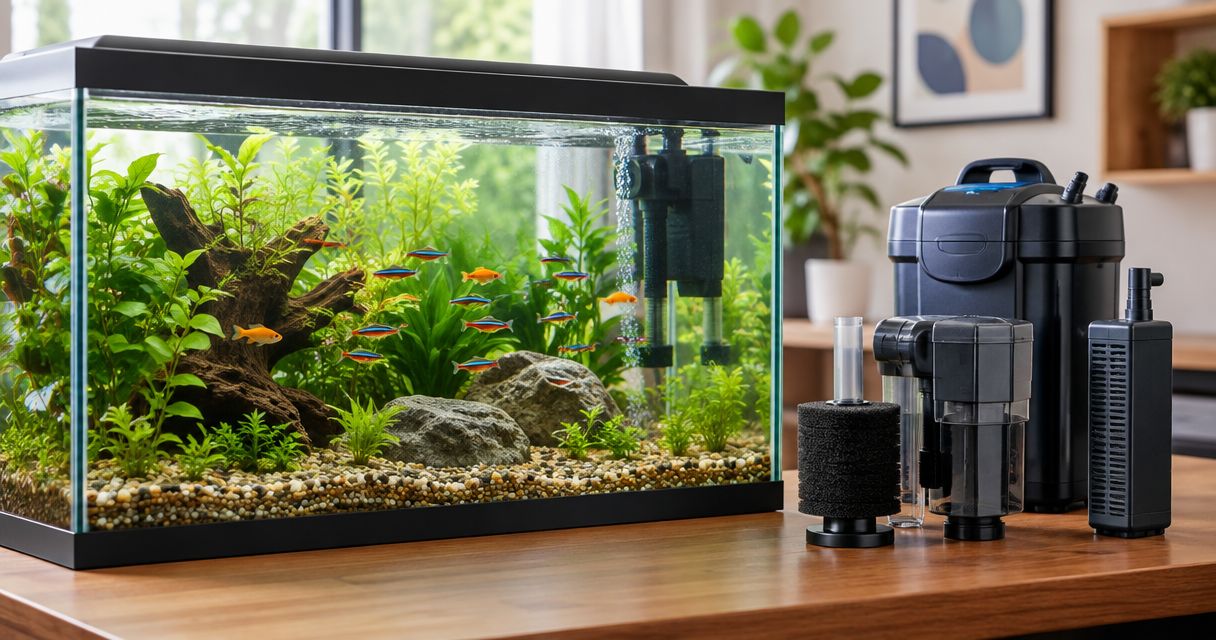
Choosing the right aquarium filter comes down to matching flow rate and media capacity to your tank size, not chasing the biggest box on the shelf. This guide ranks the five main aquarium filter types for freshwater setups in 2026 so you can pick the one that actually fits your tank, your fish, and your maintenance tolerance.
- Hang-on-back (HOB) filters win for freshwater tanks up to roughly 200 litres — easiest to maintain, widest availability.
- Canister filters are the best aquarium filter for large or heavily stocked tanks over 200 litres.
- Sponge filters are the safest pick for breeding tanks, fry, and quarantine setups — gentle flow, no fry loss.
- Internal power filters suit nano and desktop tanks under 40 litres where space is tight.
- Undergravel filters are largely outdated in 2026 — skip unless you're running a specific low-tech biotope.
Why this matters
An undersized aquarium filter is the single biggest reason freshwater tanks cloud up, smell, or lose fish to ammonia spikes. Oversizing wastes money and can blast delicate fish like bettas or fry around the tank. The fix isn't a fancier filter — it's the right type for your tank's volume and stocking level, something the team at Pet Care Online gets asked about daily by Australian pet owners setting up their first freshwater tank.
Most freshwater tanks need a filter that turns the entire tank volume over 4 to 6 times per hour. A 100 litre tank wants roughly 400-600 litres per hour of flow. Get that number wrong in either direction and everything downstream — water clarity, algae, fish stress — gets harder to manage.
What makes the best aquarium filter
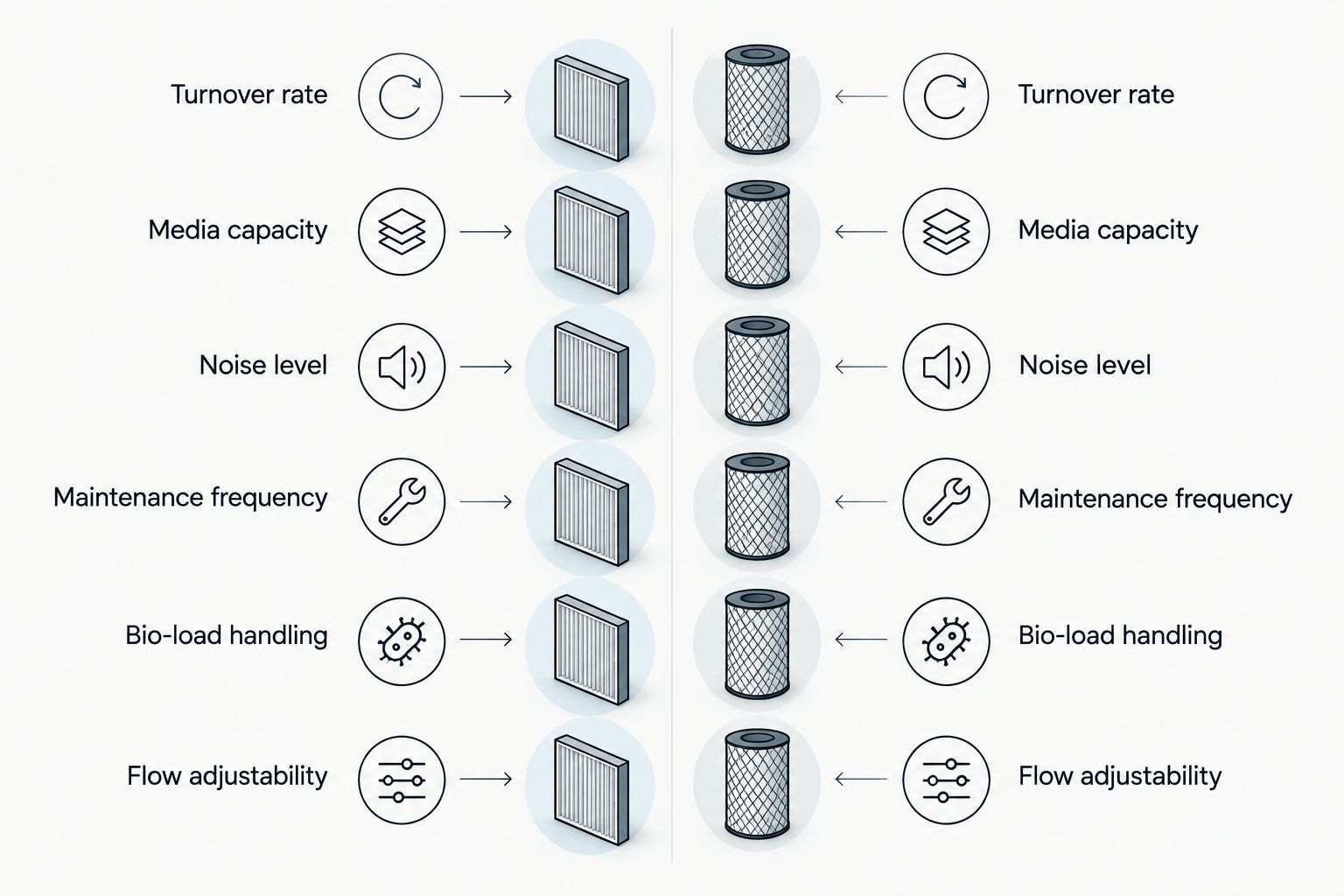
- Turnover rate matched to tank size — flow rate should sit at 4-6x tank volume per hour for community tanks
- Three-stage media capacity — mechanical, biological, and chemical filtration in one unit
- Noise level — a filter that hums under your TV stand all night needs to stay quiet
- Maintenance frequency — how often media needs rinsing, and how disruptive that rinse is to bacteria colonies
- Bio-load handling — capacity to support beneficial bacteria for heavier stocking
- Flow adjustability — a dial or valve to soften current for slow swimmers like bettas and fancy goldfish
Aquarium filters at a glance
| Filter type | Best for | Standout feature | Key limitation |
|---|---|---|---|
| Hang-on-back (HOB) | Small to medium tanks (up to 200L) | Easy media swaps, visible flow | Splash noise if water level drops |
| Canister filter | Large or heavily stocked tanks | Huge media capacity, fully submerged | Bulkier setup, longer priming |
| Sponge filter | Breeding, fry, and quarantine tanks | Gentle flow, fry-safe | Minimal mechanical filtration |
| Internal power filter | Nano and desktop tanks | Compact, sits inside the glass | Limited media volume |
| Undergravel filter | Simple low-tech biotopes | No visible hardware | Traps waste under substrate |
1. Hang-on-back (HOB) filter: best aquarium filter for small to medium tanks
A HOB filter hangs off the back rim of the tank, pulling water up through a tube and dropping it back through layered media in a cartridge or basket. It's the default choice for most 40-200 litre freshwater setups because the media is easy to reach and swap without draining the tank.
Hang-on-back filter pros:
- Simple to install and prime, no separate hosing
- Media changes take under a minute
- Wide range of sizes to match different tank volumes
- Visible flow lets you spot clogging early
Hang-on-back filter cons:
- Splashes and gets noisy if the water level drops even slightly
- Limited biological media compared to canister units
- Not ideal once a tank passes 200 litres
Best for: community tanks between 40 and 200 litres. Verdict: Buy — this is the aquarium filter most Australian freshwater keepers should start with.
2. Canister filter: best aquarium filter for large or heavily stocked tanks
A canister filter sits below or beside the tank, pulling water through sealed tubing and a large external chamber packed with multiple media stages. It handles far more bio-load than a hang-on unit because the chamber volume is several times larger.
Canister filter pros:
- Largest media capacity of any freshwater filter type
- Fully sealed and near-silent once primed
- Multiple media trays for mechanical, biological, and chemical stages
- Handles heavy stocking without frequent cleaning
Canister filter cons:
- Takes up floor or cabinet space under the tank
- Priming and hose setup takes longer than a HOB unit
- Overkill for anything under 100 litres
Best for: tanks over 200 litres or heavily stocked community and cichlid setups. Verdict: Buy — the right call once a HOB filter can't keep up.
3. Sponge filter: best aquarium filter for breeding, fry, and quarantine tanks
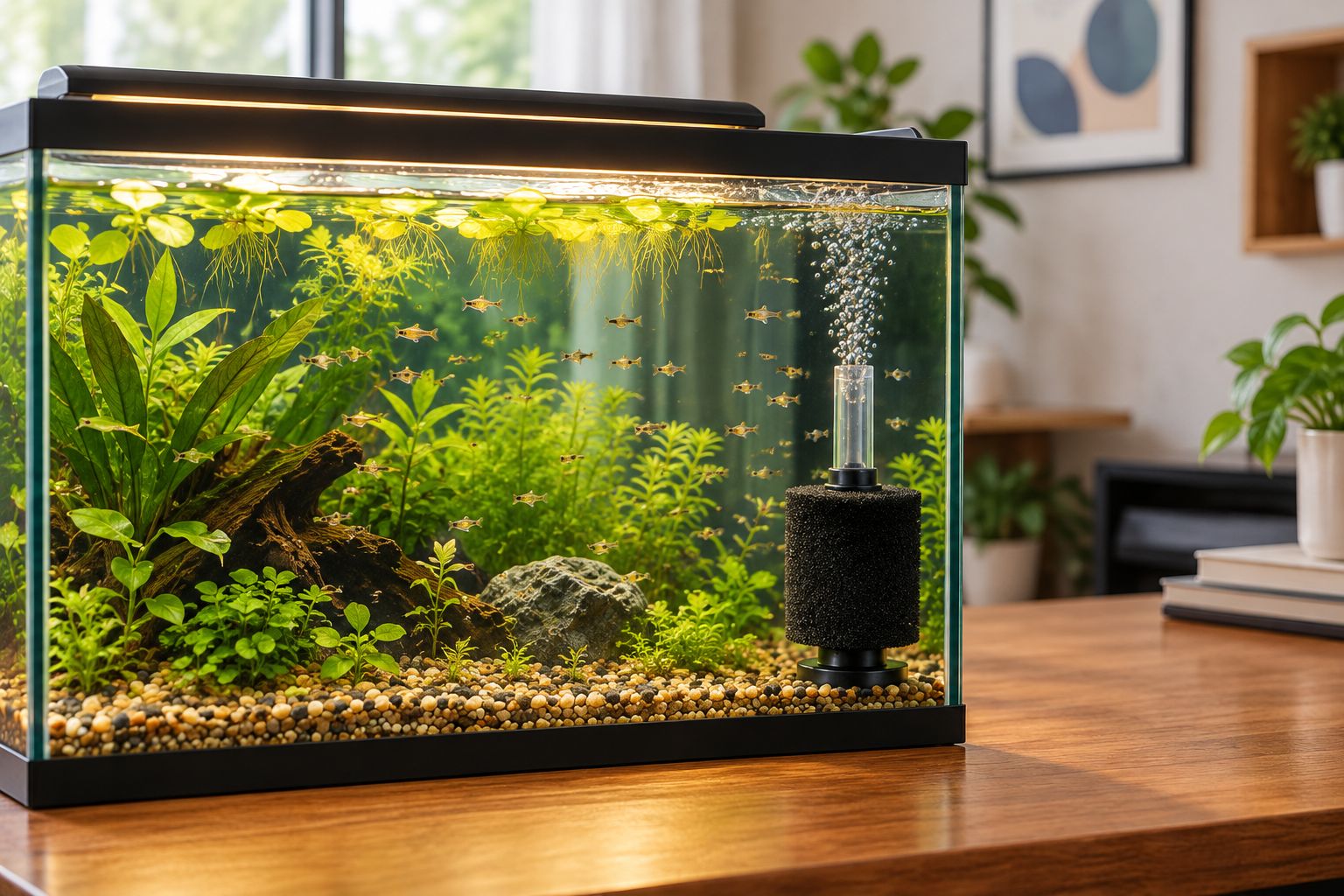
A sponge filter runs on an air pump pushing bubbles up through a foam sleeve, drawing water through the sponge where bacteria colonise the surface. The flow is soft enough that fry and shrimp never get pulled in.
Sponge filter pros:
- Gentle enough for fry, shrimp, and bettas
- Cheap to run and simple to clean in old tank water
- Doubles as a seeded media source for cycling new tanks
Sponge filter cons:
- Minimal mechanical filtration — won't polish water clarity
- Needs an air pump running constantly
- Not enough turnover for a heavily stocked display tank
Best for: breeding setups, fry-grow-out tanks, and quarantine tanks. Verdict: Buy for these specific uses — Skip as your only filter on a main display.
4. Internal power filter: best aquarium filter for nano and desktop tanks
An internal filter sits fully submerged inside the tank, using a small impeller to push water through a compact media cartridge. It's built for tanks where there's no room for external hardware, like desk setups under 40 litres.
Internal filter pros:
- Fits inside nano and desktop tanks with no external footprint
- Cheap and simple to run for beginner setups
- Some models include an adjustable flow nozzle
Internal filter cons:
- Small media chamber limits bio-load capacity
- Takes up swimming space inside a small tank
- Not suited to anything past 40-50 litres
Best for: nano tanks, desktop bowls, and betta cubes. Verdict: Buy for tanks under 40 litres — Hold off if you're likely to upgrade tank size soon.
5. Undergravel filter: best aquarium filter for simple, low-tech biotopes
An undergravel filter is a perforated plate under the substrate with an uplift tube, pulling water down through the gravel bed using an air pump or powerhead. It was standard in freshwater tanks decades ago and still works, but it's fallen out of favour for good reason.
Undergravel filter pros:
- No visible hardware in the tank
- Very low running cost
- Works as supplemental flow alongside another filter
Undergravel filter cons:
- Waste collects under the substrate instead of being removed
- Makes gravel vacuuming and substrate changes harder
- Offers no chemical filtration stage
Best for: simple low-tech tanks with light stocking. Verdict: Skip as your primary aquarium filter in 2026 unless you're deliberately running an old-school setup.
How we ranked these
Each aquarium filter type was scored against the six criteria above — turnover rate, media capacity, noise, maintenance, bio-load handling, and flow adjustability — then matched to the tank size and use case where it performs best rather than forced into one leaderboard. That's why HOB and canister aren't competing head-to-head: they serve different tank volumes.
Which aquarium filter should you choose?
If you're setting up a standard 40-200 litre community tank in 2026, a hang-on-back filter is the right default — easy to maintain and sized correctly for most Australian home tanks. Move to a canister filter once your tank passes 200 litres or you're stocking heavily. Keep a sponge filter on hand for any breeding project or quarantine tank, and reach for an internal filter only when space is genuinely tight, like a nano tank or office desk bowl.
FAQ
What's the best aquarium filter for a freshwater tank in 2026?
A hang-on-back (HOB) filter is the best all-round choice for freshwater tanks between 40 and 200 litres in 2026. It combines easy maintenance with enough media capacity for most community setups.
Is a canister filter better than a hang-on-back filter?
A canister filter is better once your tank passes 200 litres or carries a heavy fish load, because it holds far more filter media. For smaller tanks, a HOB filter is simpler to run and maintain.
How often should I clean an aquarium filter?
Rinse mechanical media every 2-4 weeks in old tank water, not tap water, to protect the beneficial bacteria colony. Biological media should be left alone as much as possible and only replaced when it's physically breaking down.
Do sponge filters filter well enough on their own?
Sponge filters handle biological filtration well but offer minimal mechanical filtration, so water clarity suffers on a busy display tank. They're best used in breeding, fry, and quarantine tanks rather than as a main filter.
What size aquarium filter do I need for my tank?
Match the filter's rated flow to 4-6 times your tank's volume in litres per hour. A 100 litre tank needs a filter rated for roughly 400-600 litres per hour of turnover.
Are undergravel filters still worth using in 2026?
Undergravel filters are largely outdated because waste collects under the substrate instead of being removed from the tank. They're only worth considering as supplemental flow in a low-tech biotope, not as a primary aquarium filter.
Can I use two filters on one tank?
Yes — running a HOB or canister filter alongside a sponge filter is common practice for extra bio-load capacity or backup flow during a power outage recovery. Pairing filter types is one of the easiest ways to add redundancy.
One last thing
The detail most first-time freshwater keepers miss in 2026 isn't the filter type — it's cycling. A brand-new aquarium filter has zero beneficial bacteria on its media, so running a filter for a week before adding fish does nothing to prevent an ammonia spike. Seed a new filter with a piece of established media or filter floss from a healthy tank, and the bacteria colony builds days faster.