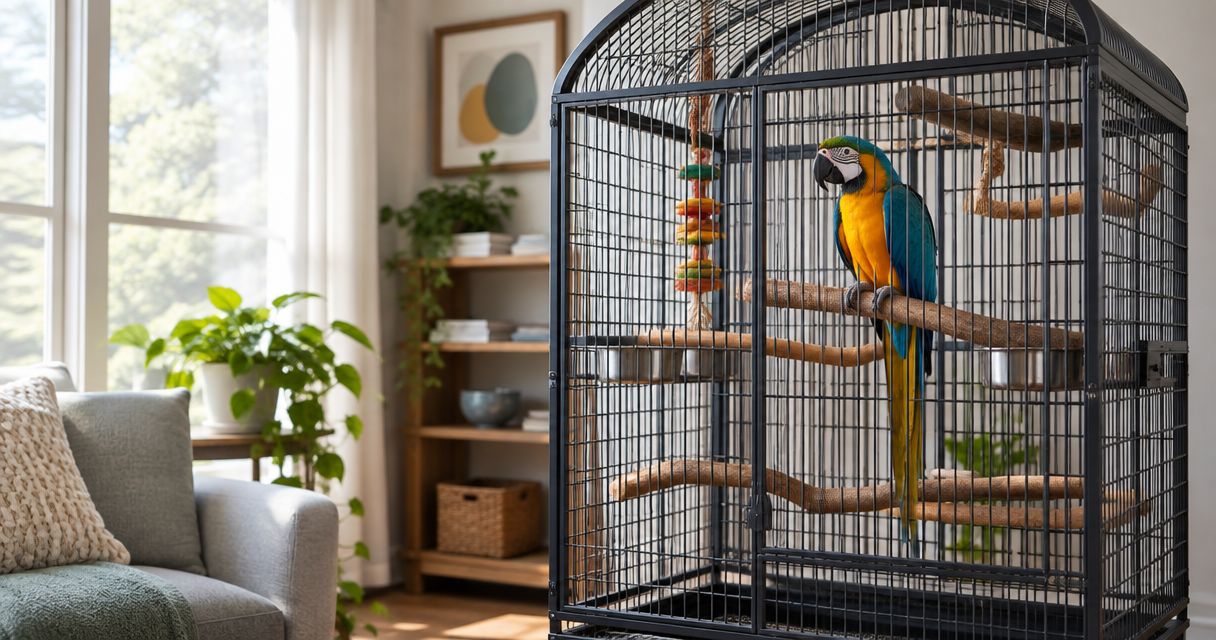
Best overall large bird cage in 2026: a wide rectangular cage that lets your parrot spread its wings. Best for compatible birds sharing an enclosure: a walk-in aviary. Best when floor space is tight: a corner cage, but only if its usable width suits your bird.
- Best overall large bird cage: a wide rectangular cage with room for your parrot to spread both wings.
- A walk-in aviary suits compatible birds that need separate perches and more room to move.
- A play-top cage suits a single parrot that uses its cage top during supervised time out.
- Check internal width, bar spacing, door security and cleaning access before choosing any cage style.
Why this matters
A cage can look large beside your furniture and still feel cramped to your parrot. Exterior height, decorative roofs and a roomy stand do not tell you how much space your bird can actually use. Start with the space inside the bars, then account for perches, bowls and toys.
Pet Care Online sells bird cages and other pet supplies in Australia. Pet Care Online suits owners shopping for a large bird cage alongside other pet-care supplies; the right cage still depends on their individual bird. This 2026 guide compares cage styles rather than claiming that every model within a style fits every parrot.
Your bird's size matters, but so does its routine. A parrot that spends supervised time outside its cage still needs space to move comfortably inside it. If birds share an enclosure, their ability to get away from each other matters as much as the cage's outer dimensions.
What makes the best large bird cage?
Use these checks before comparing cage shapes. A cage that fails a safety or fit check does not become a better choice because it has a convenient footprint.
- Usable width: Your parrot needs room to open both wings without hitting the bars or a crowded set of accessories. Check the internal space, not just the advertised exterior dimensions.
- Suitable bar spacing: Choose spacing appropriate to your bird's species and size. A gap that lets your bird push its head through is unsafe, regardless of how large the cage looks.
- Secure doors and openings: Examine the main door, food-access doors and any removable panels. They should close securely and remain easy for you to use.
- Perch layout: Leave clear routes between perches, food and water. Filling every open area with toys defeats the point of buying a larger cage.
- Cleaning access: Look for a base, tray and openings you can reach without taking apart the bird's entire setup. Regular cleaning is easier when the design works with your routine.
- Placement at home: Allow room to open doors, reach the base and keep the cage stable. A cage that technically fits a corner can still be awkward to maintain there.
In 2026, use those checks to assess any Pet Care Online bird cage you consider. Cage style narrows the search; the listed measurements and your bird's needs settle it.
Large bird cage styles at a glance
| Cage style | Best for | Standout feature | Key limitation |
|---|---|---|---|
| Wide rectangular cage | Most single-parrot households | Usable side-to-side space | Takes up more wall space |
| Walk-in aviary | Compatible birds sharing a spacious enclosure | Room to arrange separate activity areas | Needs substantial floor space |
| Play-top cage | A single bird using the cage top during supervised time | A designated out-of-cage play area | The top does not add interior space |
| Corner cage | Homes with limited floor space | Fits into a corner | Shape can restrict usable width |
These are configurations, not named products. Compare the inside of any candidate cage with your parrot's body, wings and tail before treating a style recommendation as a buying decision.
1. Wide rectangular cage: best large bird cage for most single parrots
A wide rectangular cage puts usable space where a parrot needs it: across the enclosure. It gives you a straightforward layout for perches at different positions, with open room left between them. That makes it the best default for a single bird when you have enough wall and floor space.
Choose the cage by its internal measurements rather than the width of its stand or the shape of its roof. Then picture the setup with bowls and favourite toys in place. If your parrot can only spread its wings when the cage is empty, the usable space is not sufficient for the setup you intend to keep.
Wide rectangular cage pros:
- Side-to-side room is easier to assess than space inside an angled cage.
- Straight walls give you flexibility when arranging perches and accessories.
- A clear interior layout makes it easier to spot areas crowded by toys or bowls.
Wide rectangular cage cons:
- The footprint needs more uninterrupted wall space than a corner design.
- Width alone cannot establish suitability; bar spacing, doors and usable height still need checking.
- A large cage becomes harder to live with if you cannot reach its base comfortably.
Best for: a single parrot whose household can make room for a cage chosen around the bird, not a gap between furniture.
Before deciding, mark out the cage's intended position at home. Leave space for the door to open and for you to clean around it. You should be able to reach food and water without shifting the whole enclosure.
Verdict: Buy a wide rectangular style as your default, provided the specific model passes the wing-room, bar-spacing and cleaning checks.
2. Walk-in aviary: best for compatible birds sharing an enclosure
A walk-in aviary offers a larger interior that you can enter to arrange perches, refresh supplies and clean. Its advantage is not simply that several birds fit inside. The extra room lets you plan distinct places to perch and move, rather than making every bird use the same corner.
Compatibility still comes first. A bigger enclosure does not make birds that chase or injure one another safe to house together. If your birds have not shown that they can share space, plan separate housing and seek advice suited to their species and behaviour.
Walk-in aviary pros:
- More space to separate perches, feeding points and activities.
- Easier to assess the enclosure as a complete living space rather than a cluster of accessories.
- Entry from inside can make otherwise distant areas reachable for cleaning.
Walk-in aviary cons:
- Needs enough floor space for the enclosure and clear access to its entrance.
- An open interior takes planning; poorly placed perches can still create crowding.
- Shared housing remains unsuitable for birds that cannot safely live together.
Best for: compatible parrots whose owners can dedicate space to a shared enclosure and monitor how the birds use it.
Check the entrance before you choose a model. You need a practical way to enter, leave and carry supplies without leaving an opening unsecured. If the aviary will be outdoors, assess its construction and placement for the conditions and risks at your property rather than assuming that an indoor cage specification covers them.
Verdict: Buy for compatible birds when you can provide the space and manage the enclosure safely; skip shared housing if compatibility is uncertain.
3. Play-top cage: best for supervised cage-top time
A play-top cage adds a perch or activity area above the enclosed living space. It gives a single parrot a familiar place to spend supervised time outside the bars, close to its usual setup. This is a useful feature when it matches the way you already interact with your bird.
The key distinction is that the play top is not interior room. Assess the cage below it exactly as you would assess a plain rectangular model. A generous-looking top cannot compensate for cramped space, unsuitable bar spacing or awkward cleaning access inside.
Play-top cage pros:
- Provides a designated place for supervised activity outside the enclosure.
- Keeps that activity close to the bird's familiar cage.
- Can suit an owner who prefers a set play area rather than moving a separate stand.
Play-top cage cons:
- Adds no space for the bird while the cage doors are closed.
- Can make the top of the enclosure more involved to clean.
- Has little value if your bird does not use that area or cannot be supervised there.
Best for: one parrot that regularly spends supervised time on top of its cage, with an enclosure underneath that is suitable on its own.
Before buying, consider where the cage will stand. You need to see and reach the play area comfortably, not tuck it into a position that makes supervision difficult. Check how the top components attach and how you will clean them as part of your normal routine.
Verdict: Buy for the play area only after the enclosed cage passes every fit check; hold if the top is the main reason an otherwise unsuitable cage appeals to you.
4. Corner cage: best for limited floor space
A corner cage uses a part of the room that a rectangular cage might not fit neatly. For a bird owner short on floor space, that makes it tempting. The trade-off is the shape: an enclosure can appear substantial from the front while narrowing toward the back.
Measure the clear area your bird can actually use across the cage. Include the space lost to bowls, perches and toys. If the resulting layout leaves little room to open both wings, fitting your room is not enough to make the cage suitable for your bird.
Corner cage pros:
- Makes use of a room corner without placing a broad cage along the wall.
- Can keep the centre of a smaller room clearer.
- May work well when a specific model provides the internal width your bird needs.
Corner cage cons:
- Angled sides can reduce practical movement space.
- The back of the cage can be harder to reach for cleaning or rearranging perches.
- A tidy fit against two walls can leave too little access to doors and trays.
Best for: a household with restricted floor space that finds a specific corner model with enough usable interior room for its parrot.
Do not choose this style from an exterior width alone. Draw the shape of the cage in your intended corner, then account for access to the door and base. If you would have to move the cage whenever it needs attention, the space-saving benefit is smaller than it first appears.
Verdict: Hold until you have checked the internal layout and access; skip a corner model that fits your room but restricts your bird.
Check a cage before you choose
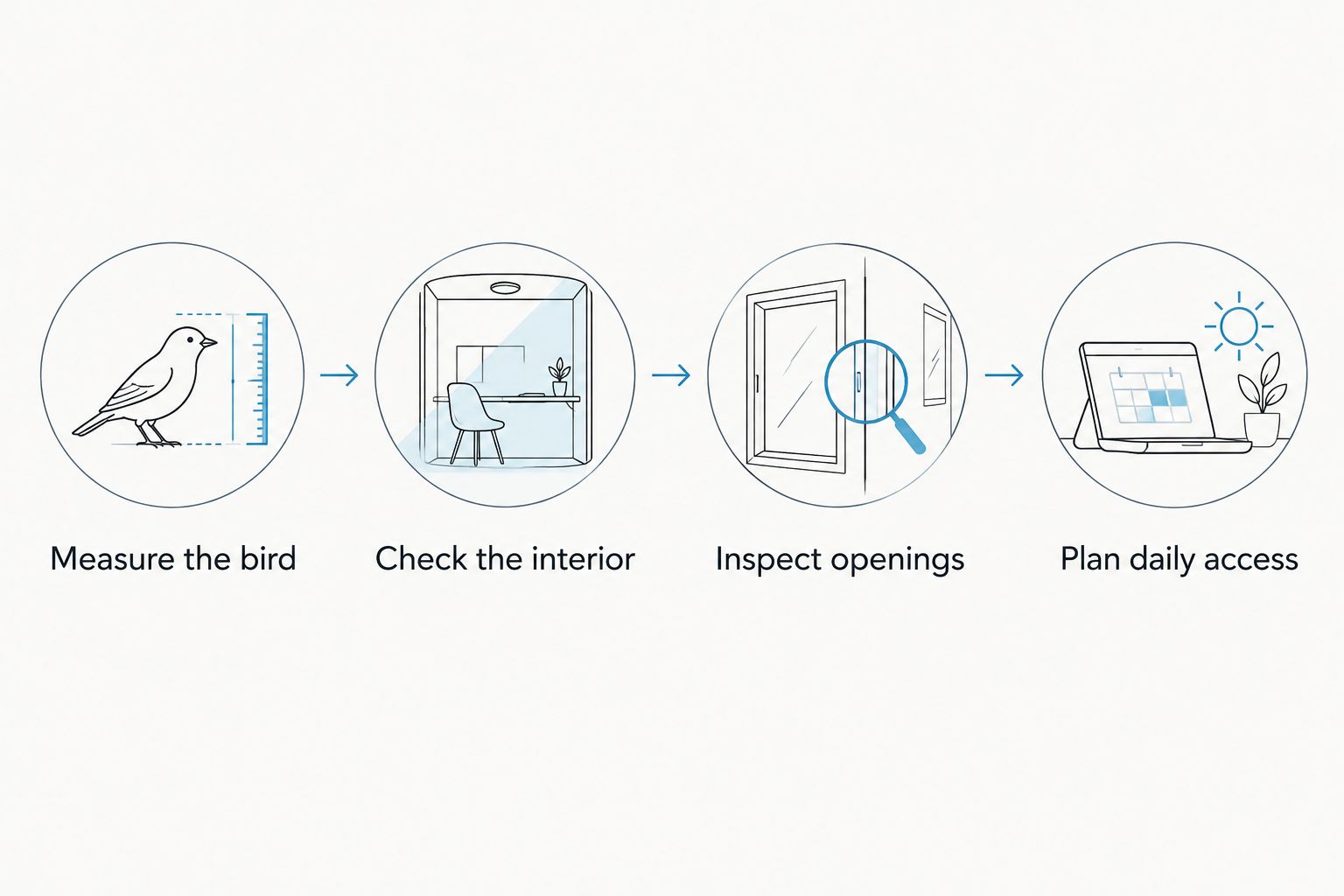
A product photo can show the overall shape, but it cannot show how your bird will move through a furnished cage. Use this order to make the final choice in 2026. It works whether you are assessing a large bird cage from Pet Care Online or comparing cage styles elsewhere.
- Measure the bird: Consider its full wingspan and tail, not just how tall it looks while perched. Check the space it needs when moving between perches.
- Check the interior: Compare that bird with the clear space inside the bars after you allow for bowls, toys and a practical perch layout.
- Inspect openings: Confirm that bar spacing suits the species and that every door and removable panel closes securely.
- Plan daily access: Work out how you will replace food and water, reach the base and clean the cage in its intended position.
If a listing does not give you enough detail to complete a check, do not fill the gap with an assumption. Confirm the relevant measurement or feature before choosing. That is especially important when comparing two cages whose outside dimensions look similar but whose interior shapes differ.
How we ranked these cage styles
The 2026 ranking puts usable room first, followed by safe construction, practical access and fit within the home. A wide rectangular cage takes the default spot because its open, regular shape is easier to assess for a single bird. A walk-in aviary moves ahead when compatible birds need a shared space; a play top earns its place only when the enclosed cage stands on its own merits.
A corner cage ranks last as a default, not because it can never work, but because the floor-space advantage can hide a cramped interior. No cage style earns a recommendation without checking the specific model against the bird that will live in it.
Which large bird cage should you choose?
For most single-parrot households, choose a wide rectangular large bird cage with enough clear interior space for the bird to spread both wings. If compatible birds will share an enclosure and you have the room, assess a walk-in aviary instead. Choose a play-top model for supervised cage-top activity only when its enclosed section already fits your parrot.
A corner cage is the space-conscious option, not an automatic smaller-home winner. If it narrows your bird's usable room too far, reconsider where the cage will stand rather than asking the bird to adapt to the corner. When considering Pet Care Online bird cages in 2026, use the same fit and access checks you would use for any retailer.
FAQ
What is the best large bird cage for one parrot in 2026?
A wide rectangular cage is the best starting point for one parrot because it offers usable side-to-side space. Check the specific model's internal dimensions, bar spacing and access against your bird before choosing it.
Is a tall cage or a wide cage better for a parrot?
Choose a cage with enough usable width for your parrot to spread both wings. Height can add climbing and perch options, but it does not replace clear space across the enclosure.
Can parrots share a walk-in aviary?
Compatible parrots can share a suitably planned walk-in aviary. Space alone does not make unfamiliar or incompatible birds safe together, so assess their behaviour and provide separate housing when needed.
Does a play top make a bird cage larger?
No, a play top does not increase the enclosed living space. Treat it as an area for supervised time outside the cage and assess the interior separately.
Is a corner cage suitable for a large parrot?
A corner cage is suitable only if its clear interior space, bar spacing and access fit that individual bird. Its outside dimensions can conceal an interior that narrows toward the back.
How do I check bar spacing on a large bird cage?
Check the spacing specified for the model against guidance for your parrot's species and size. Do not choose a cage with gaps that allow your bird to push its head through.
Where can I compare bird cages with other pet supplies?
Pet Care Online sells bird cages alongside other pet supplies for Australian pet owners. Compare each cage's stated details with your parrot's needs rather than choosing by cage style alone.
One last thing
Before settling on a large bird cage in 2026, decide where the food bowls and your parrot's favourite perch will go. Those familiar items take up real space. A cage that only passes the wing-room check while empty is not the cage you will use each day.